Beautiful Boy Absalom
The tragic tale of a father who refused to look past his love for his son.
July 14, 2026
I asked Google: Tell me all that is known about King David and his son Absalom. It’s such a tragic story ending with the sorrow of a father. Frame it as a story, beginning with, “In the time of King David...”
Google’s response, with my additions in blue:
In the time of King David, there was no man in all of Israel so praised for his breathtaking appearance as David’s third son, Absalom. From the sole of his foot to the crown of his head, there was not a single blemish upon him. His most magnificent feature was his thick, luxurious hair. It grew so heavy that he could only cut it once a year, and when weighed, the shorn locks tipped the scales at five pounds. King David looked upon this flawless, striking son with immense fatherly pride, seeing in him the very crown jewel of the royal house.
Yet, beneath this veil of physical perfection lay a deep, brewing darkness. The tragedy began years before, likely when Absalom was a young boy. You may know the story; Bathsheba happened to be outside bathing at the time of the king’s evening walk on the roof of his palace. Her husband wasn’t just any old guy—he was one of The Thirty, the king’s greatest warriors. He probably lived nearby because he was a key member of the king’s personal guards.
But at this moment Uriah was in battle and his wife was all alone. So David slept with her. When she discovered she was pregnant, he tried to get Uriah to come home and lay with his wife to hide the dirty secret. But Uriah wouldn’t even accept the food David offered for a romantic meal. He bunked down with the guards at the gates of the palace, lest he enjoy comfort while his unit was still out fighting. So David had no other option—he sent orders to have Uriah killed. Bathsheba’s baby died and the prophet Nathan then confronted the king and told him the sword would never be removed from his house.
Fast forward to his sons coming of age. Amnon, the eldest son of King David and heir to the throne desired Absalom’s sister, Tamar, but rather than marry her he took her and then left his half-sister disgraced. Amnon seemed to think he could get away with anything, just as his father had done. But it gets worse.
David failed to punish Amnon’s crime. Eventually, Absalom took vengeance into his own hands, assassinating his half-brother at a feast before fleeing into exile. Though David eventually allowed his beautiful son to return to Jerusalem, a wall of silence stood between them. For two years, the prince was forbidden from seeing the king’s face, causing Absalom’s grief to harden into bitterness.
Now Chileab, David’s second son, was born to Abigail who had formerly been the wife of the foolish Nabal. This son did not live long enough to vie for his father’s throne and so is known in rabbinic tradition to be a son without sin. Thus, the next person in line for David’s throne was Absalom. Yet with a chasm of grief between the two of them, there could be no proper transition of power from father to son. The king was in his sixties and Absalom in his twenties when it seemed like something would have to change.
Over time, Absalom used his unmatched charm and striking looks to steal the hearts of the people. He stood at the city gates, dazzling all who passed, kissing the hands of commoners and promising them true justice. `
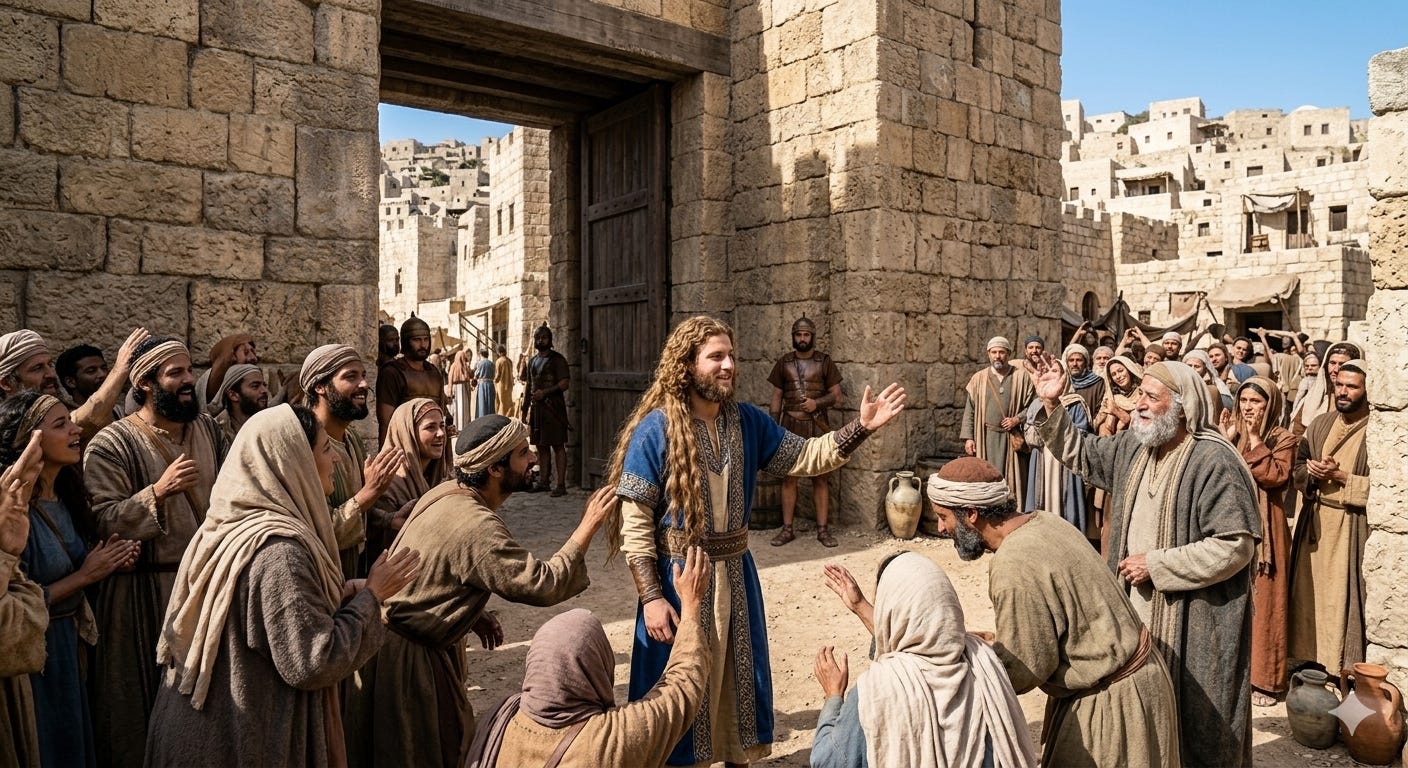
Having built a massive following, the prince launched a sudden, violent rebellion. Caught completely off guard, the aging king was forced to flee Jerusalem in tears, while his own son moved into the palace.
According to the book of Samuel, “David continued up the Mount of Olives, weeping as he went; his head was covered, and he was barefoot. And all the people with him covered their heads and went up, weeping as they went.”
In this darkest time of his old age, the great king wrote Psalm 3:
A Psalm of David, when he fled from Absalom his son.
1 O Lord, how many are my foes!
Many are rising against me;
2 many are saying of me,
there is no help for him in God. Selah3 But thou, O Lord, art a shield about me,
my glory, and the lifter of my head.
4 I cry aloud to the Lord,
and he answers me from his holy hill. Selah5 I lie down and sleep;
I wake again, for the Lord sustains me.
6 I am not afraid of ten thousands of people
who have set themselves against me round about.7 Arise, O Lord!
Deliver me, O my God!
For thou dost smite all my enemies on the cheek,
thou dost break the teeth of the wicked.8 Deliverance belongs to the Lord;
thy blessing be upon thy people! Selah
(RSV)
For the king recognized that this was no longer a private family dispute; it had become a chance for sweeping political opportunism. Traitors like his former top advisor, Ahithophel, and thousands of rebellious citizens had thrown in with Absalom.
His song is that of a shepherd who knows a predator like a lion or a wolf is only dangerous because of its fangs. If you smash its jaw and break its teeth, it is rendered harmless, and it must drop its prey. David was not asking for his son or even his citizens to be brutally mutilated or killed. He was praying for God to shatter the biting power of the rebel army so they could no longer hunt him down.
The conflict reached its climax in the dense Forest of Ephraim, where David’s loyal army marched out to meet Absalom’s rebel forces. Even as his crown and life hung in the balance, the king’s heart belonged to his boy. He stood by the city gate and gave a strict, desperate command to his generals: “Deal gently for my sake with the young man, even with Absalom.”
The battle was fierce, and the rebel army was thoroughly crushed. As Absalom fled the chaos on his royal mule, he rode beneath the thick, tangled boughs of a great oak tree. In a cruel twist of fate, his magnificent, heavy hair—the very symbol of his pride and beauty—became securely tangled in the branches. The mule ran out from under him, leaving the flawed prince hanging helplessly in mid-air.
When David’s ruthless commander, Joab, discovered the trapped prince, he completely disregarded the king’s plea. Joab plunged three javelins directly into Absalom’s heart, and his soldiers threw the lifeless, beautiful body into a deep pit, covering it with a careless heap of stones.
When the news reached Jerusalem, there was no celebration of victory. King David collapsed in the chamber over the gate, weeping uncontrollably. His agonizing cries echoed through the stone corridors: “O my son Absalom! My son, my son Absalom! Would I had died instead of you, O Absalom, my son, my son!” The victorious soldiers slunk back into the city in silence, completely heartbroken by the sight of a king whose pride had turned to absolute, shattering sorrow.
Following these bitter days of mourning, the tragic tale reached its final, sobering chapter of leadership and duty:
While David was locked away in his chambers, weeping uncontrollably for his fallen son, a deep resentment began to poison the victorious army. The soldiers who had risked their lives to defend the crown slunk into Jerusalem like criminals, humiliated that their king valued the life of a traitor above their own survival.
Seeing the kingdom on the brink of a second, emotional collapse, Joab marched directly into the palace to confront the grieving monarch. With fierce, unvarnished candor, he warned David that his excessive sorrow was insulting his most loyal subjects, declaring, “You love those who hate you and hate those who love you.” He gave the old king a stark ultimatum: rise up, dry his tears, and encourage his people, or face a total desertion that would leave him completely alone by nightfall.
Shaken by the raw truth of his advisor’s words, King David forced his grief into the shadows. He rose, walked down to the city gates, and took his seat before the public, thus restoring the stability of a fractured nation, even as his heart remained buried in the forest pit with his beautiful, misguided son.
On July 29th I asked: What about Absalom's statue to himself--where does that fit in the dynamic? I takes time to commission and build a statue.
Google: The detail of Absalom's pillar (often referred to as his monument or statue) is a crucial psychological and narrative anchor in the story. It is introduced in 2 Samuel 18:18 right after he is killed and thrown into a messy, unceremonious pit of rocks. [1, 2, 3]
- The Timing: It was likely built during the years he spent quietly plotting his coup. After returning from exile, he spent four years undermining David's authority by sitting at the city gates, acting as a "man of the people." [1, 2, 3, 4, 5]
- The Statement: Placing a massive stone pillar in the King's Valley during David's reign was an audacious, slow-burn claim to royalty. It was highly visible to the public, signaling that he viewed himself as the true heir—or the current ruler—in waiting. [1, 2, 3, 4]
- The Contradiction: Interestingly, 2 Samuel 14:27 states that Absalom actually had three sons and a daughter.
- The Tragedy: Most historians and commentators conclude that his sons must have died at a young age. This reveals a deeply fragile ego beneath Absalom's beautiful, confident exterior. Terrified that his biological line was wiped out and that he would be forgotten, he engineered a cold stone replacement to force history to remember him. [1, 2, 3, 4, 5]
- The Monument: He meticulously designed a beautiful, prestigious pillar in the King's Valley to celebrate his glory.
- The Reality: He died hanging helplessly from a tree, hacked to death by his father's general. His body was dumped into a jagged pit in a wild forest and covered in a crude heap of stones. He never got to lie near his grand monument. [1, 2, 3, 4, 5]


Comments
Post a Comment