Good Church/Bad Church
Why the Bereans Never Got a Letter
I said to Google: The Bible in a year New Testament reading from our daily bread on July 11 talks about those evil men from Thessalonica. Yet later we have Paul’s letters to the Thessalonians. What’s the full story on that group of believers?
Google: The "evil men from Thessalonica" were local troublemakers who incited an anti-Christian riot, driving Paul out of the city. Despite this hostile start, the Thessalonian church became one of the most resilient and vibrant early Christian communities, prompting Paul to write his letters to encourage and guide them. [1, 2, 3, 4, 5]
The saga of the Thessalonian believers unfolds as a thrilling narrative of rapid church growth followed by intense persecution: [1]
The Founding: Around \(50\) AD, during his second missionary journey, Paul and Silas visited Thessalonica. Preaching in the local synagogue, Paul successfully established a church that included Jews, Greeks, and prominent women (Acts \(17:1\)-\(4\)). [1, 2, 3, 4, 5]
The Riot: Jealous of Paul's success, oppositional leaders formed a mob, accusing the Christians of treason against Caesar by proclaiming "another king, one called Jesus." The mob attacked the home of Jason (a new believer who had hosted Paul), forcing the missionaries to secretly flee to the neighboring city of Beroea (Acts \(17:5\)-\(10\)). [1, 2, 3, 4, 5]
The Persecution: Those same hostile men followed Paul to Beroea to stir up trouble, forcing Paul to travel to Athens and leaving the newly founded Thessalonian church highly vulnerable and isolated. [1, 2, 3, 4]
Paul's Letters: Concerned, Paul sent his associate Timothy back to check on the young church. Overjoyed by Timothy's report of their unwavering faith in the face of brutal persecution, Paul wrote 1 Thessalonians to praise their endurance and clarify teachings about the return of Jesus. He later wrote 2 Thessalonians to further comfort them in their suffering and correct misunderstandings about the end times. [1, 2, 3, 4, 5]
This group of believers ultimately became a model church, known for their deep faith, love for one another, and their boldness in spreading the message across the ancient world (1 Thessalonians \(1:7\)-\(8\)). [1, 2, 3]
Me: The Bereans never ranked a letter that we know of. What’s the story with them?
Google: The Bereans never received a dedicated New Testament letter because they did not face the complex theological crises or intense inner conflicts that required Paul's intervention. Instead, they are celebrated in church history as the gold standard for open-minded, intellectually honest scripture study. [1, 2]
The Story of the Bereans
The story of the Bereans is brief but highly impactful, found entirely in Acts 17:10–15: [1, 2]
The Escape: After escaping the riotous mob in Thessalonica, Paul and Silas fled under the cover of night to the nearby city of Beroea (modern-day Veria, Greece). [1, 2, 3, 4]
The Warm Reception: Upon arrival, Paul headed straight to the local Jewish synagogue. Unlike the hostile reception in Thessalonica, the Bereans welcomed the missionaries with great eagerness. [1, 2, 3]
The Daily Evaluation: Rather than accepting Paul’s radical claims about Jesus blindly, the Bereans listened carefully and then spent hours independently evaluating Paul's teachings against the Hebrew scriptures every single day. [1, 2, 3]
The Rapid Growth: Because they found that Paul’s message perfectly aligned with Old Testament prophecy, many prominent Greek women, men, and Jews readily believed, forming a healthy community almost instantly. [1]
The Abrupt Interruption: The peace was short-lived. The exact same troublemakers from Thessalonica traveled 50 miles to Beroea specifically to stir up crowds against Paul, forcing him to flee to Athens, while Silas and Timothy stayed behind temporarily to nurture the new believers. [1, 2, 3, 4, 5]
Why No "Letter to the Bereans"?
In the ancient world, letters (epistles) were highly functional tools. Paul wrote letters to churches that were struggling with massive problems—like the Corinthians (factionalism and immorality), the Galatians (heresy), or the Thessalonians (grief and confusion over the End Times). [1, 2]
The Bereans did not get a letter simply because they were doing exceptionally well. Because they already possessed the tools to study scripture for themselves and weed out error, they did not require the same urgent correction, defense, or doctrinal triage that other early churches desperately needed. [1, 2]
If you are interested, let me know:
Would you like to see how the historical city of Beroea compares to Thessalonica?
Me: Yes what is the extra-biblical story on these two churches?
Google: The extra-biblical, historical, and archaeological background of Thessalonica and Beroea provides a rich look at what these two early Christian communities went through outside of the text of the Bible.
Because both cities were situated in the highly strategic Roman province of Macedonia, secular history fills in the blanks regarding their distinct cultures, physical environments, and ultimate legacies.
🏛️ Thessalonica: The Metropolis of Chaos and Imperial Clash
While the Bible depicts Thessalonica as a place of instant hostility, secular history explains exactly why the city was such a powder keg for the early church.
The Politarch Inscriptions: In Acts 17, the writer Luke uses a highly specific, rare Greek term for the city officials: politarchs. For centuries, critics claimed this word was an error because it didn't exist in classical Roman literature. However, in the 1800s, archaeologists excavated an ancient archway in Thessaloniki and found an inscription explicitly naming the city rulers as "Politarchs". This discovery directly validated the precise historical setting of Paul's riot. [1, 2]
The "Another King" Trap: Thessalonica was a "free city" within the Roman Empire. This meant it enjoyed self-governance and tax exemptions, but it had to fiercely prove its loyalty to Caesar to keep those privileges. The city was heavily devoted to the Roman Imperial Cult (worshipping the Emperor as a god). When the early Christians arrived preaching "another King, Jesus," the local populace panicked. A riot was the town's way of publicly distancing itself from treason before Roman legions marched in to revoke their freedom.[1, 2, 3, 4, 5]
The Pagan Rivals: According to historical records, Thessalonica was a massive center for the Egyptian mystery cult of Isis and Serapis. Devotees practiced sacred meals, public processions, and viewed Isis as a "savior" who offered "righteousness". The young Christian church was not just competing with Jewish synagogues, but with deeply entrenched, highly funded pagan cults. [1]
The Later Legacy: Thessalonica went on to become one of the most important Christian hubs in the Byzantine Empire. In 311 AD, Emperor Galerius—one of the most brutal persecutors of Christians—fell deathly ill while ruling from Thessaloniki. In an ironic twist of history, he issued the first regional decree legalizing Christianity right from his palace, begging the Christians to pray to their God for his health. Later, his massive imperial throne room was physically converted into a Christian church. [1, 2]
📜 Beroea: The Aristocratic Retreat and the "Bema"
In contrast to the bustling, volatile port city of Thessalonica, Beroea (modern-day Veria) was a completely different historical environment. [1, 2]
The Roman "Country Club": Historically, Beroea was a wealthy, inland aristocratic retreat. Almost a century before Paul arrived, the famous Roman philosopher and politician Cicero used Beroea as a remote getaway to escape political chaos in Rome. Because it was insulated from major maritime trade and the frantic political pressure of a free port, the residents had the luxury of time, wealth, and quiet intellectual pursuit—which explains why they were so willing to study text daily.
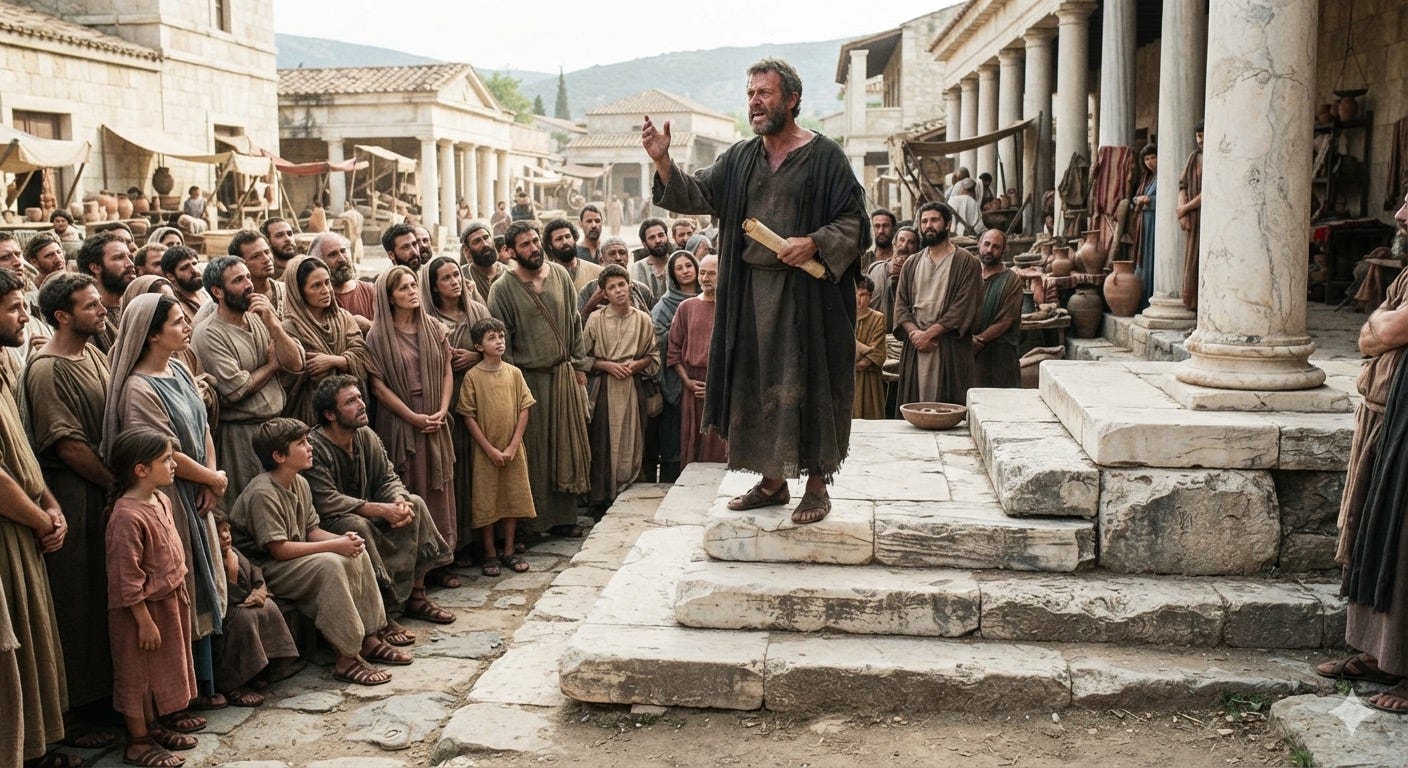
The "Bema" of Saint Paul: In modern Veria, you can still visit the Bema of Saint Paul. This open-air monument features three original 1st-century marble steps. Local tradition and historical archaeology indicate these steps were part of the actual public speaking platform where Paul stood to address the Bereans.
The First Bishop: Extra-biblical Christian texts (specifically the ancient Apostolic Constitutions) record that the Berean church quickly organized into a lasting institution. Church tradition names Onesimus—the runaway slave mentioned in Paul’s letter to Philemon—as the very first formal Bishop of Beroea.
Sopater of Beroea: The Bible mentions a Berean believer named Sopater traveling with Paul (Acts 20:4). Non-biblical inscriptions found in the region confirm that "Sopater, son of Pyrrhus" was a real, prominent aristocratic name in ancient Beroea, proving that Paul’s converts in the city included influential members of the local elite. [1, 2, 3, 4, 5, 6]
If you want to keep exploring, let me know:
Would you like to know more about the archaeological ruins you can visit in Thessaloniki today?
Do you want to look at the Via Egnatia, the famous Roman highway that connected these two cities? [1, 2]


Comments
Post a Comment