Is There Hidden Symmetry in Psalm 118?
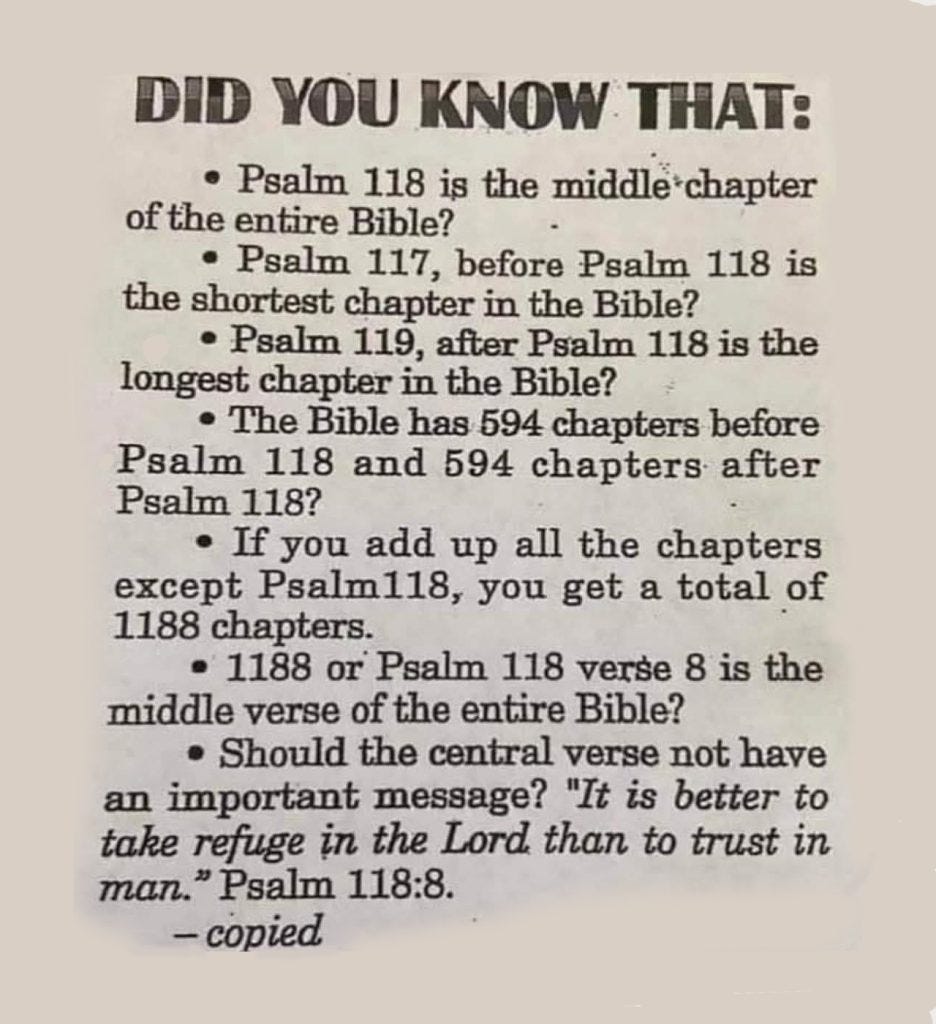
Is the mathematical placement of Psalm 118 a historical accident, or is it evidence of a higher design? How special is this psalm?
July 7, 2026
Google: Chapters were introduced by Stephen Langton, Archbishop of Canterbury, around A.D. 1220. Verses were added later: Jewish rabbi Nathan divided the Old Testament in 1448, and French printer Robert Estienne divided the New Testament and published the first unified system in 1551.
You can read more about this history on the Wikipedia or St. Paul Center pages.
Here is a more detailed breakdown of who was responsible for these additions:
Chapters: Stephen Langton, a lecturer at the University of Paris who later became the Archbishop of Canterbury, developed the chapter system around 1220. He integrated these divisions into his Latin Vulgate translation of the Bible, and they quickly became the standard.
Old Testament Verses: In 1448, a Jewish rabbi named Nathan (Isaac Nathan ben Kalonymus) divided the Hebrew Bible (Old Testament) into numbered verses.
New Testament & Combined Verses: In 1551, the Parisian printer and scholar Robert Estienne (also known as Stephanus) published a Greek New Testament that utilized a system of numbered verses. He later applied this system to the entire Bible, and the famous 1560 Geneva Bible was the first English translation to feature both chapters and verses together.
Me: If the Bible has 594 chapters with Psalm 118 at the center of it, was that the plan of the Archbishop of Canterbury or rather his group of writers who did this work?
Google: No, this was not part of a planned mathematical design by Stephen Langton, nor did he work with a specialized “group of writers” to engineer this symmetry. [1]
The idea that Psalm 118 sits perfectly at the center of the Bible with 594 chapters before it and 594 chapters after it is a mathematical coincidence resulting from a purely Protestant canon, and it was entirely accidental. [2, 3]
Here is why this phenomenon occurred, broken down step-by-step:
1. Langton Worked Individually in Paris
Stephen Langton did not create these divisions as the Archbishop of Canterbury, nor did he command a committee to arrange them layout-by-layout. He created the chapter system around 1220 while working as a theological professor at the University of Paris. He did it manually on his own copy of the Latin Vulgate Bible simply to make referencing scripture easier for his students and lecturers. [1, 4, 5, 6]
2. The Chapter Count Varies by Bible
The “594 chapters before and after” math applies strictly to the Protestant Bible canon (which has 1,189 total chapters). [2, 7]
If you calculate $594 + 594 = 1,188$ chapters.
Adding Psalm 118 itself as the single middle chapter brings the total to $1,189$. [8]
However, Langton originally divided the Latin Vulgate. Catholic Bibles include the Deuterocanonical books (like Tobit, Judith, and Maccabees), meaning a Catholic Bible has more than 1,330 chapters. In Langton’s actual historical Bible, Psalm 118 was nowhere near the mathematical center. [1, 9, 10, 11]
3. Verses Were Added Centuries Later
The internet rumor often notes that the middle verse of the Bible is Psalm 118:8. But Langton only created chapters, not verses. The verses were not added to the New Testament until 1551 by Robert Estienne—over 330 years after Langton died. Langton could not have planned for a “center verse” because verses did not exist in the Christian world during his lifetime. [8, 12, 13, 14]
4. It Is a Natural Mathematical Property
The center of any odd numbered list is found by a simple formula. For the 1,189 chapters of the Protestant Bible, the middle chapter is the 595th chapter:
(1189 + 1)/2 = 595
If you count 595 chapters into the Bible starting at Genesis 1, you land exactly on Psalm 117, not Psalm 118. Because Psalm 117 has an even lower chapter number, the exact mathematical midpoint chapter of the Protestant Bible is actually the shortest chapter in the book. Psalm 118 is just a neighbor to that center point.
Me: But what happens if you divide the Bible in half without counting Psalm 118?
Google: If you remove Psalm 118 from the Protestant Bible, you are left with exactly 1,188 chapters, which divides perfectly into two equal halves of 594 chapters. [1, 2]
This specific mathematical layout is what drives the popular trivia claim. If you isolate Psalm 118, the remaining chapters break down as follows:
First Half: There are exactly 594 chapters before Psalm 118 (starting at Genesis 1 and ending at Psalm 117).
The Center: Psalm 118 sits alone as the bridging chapter.
Second Half: There are exactly 594 chapters after Psalm 118 (starting at Psalm 119 and ending at Revelation 22). [1, 2, 3]
While this symmetrical split is a clean mathematical fact for the 1,189-chapter Protestant Bible, history shows it is a cumulative accident. Because the chapters were created in the 1200s (based on a larger Catholic canon) and the specific 66-book Protestant boundaries were finalized centuries later, no single architect ever sat down to engineer this 594-1-594 balance. It is simply a fascinating byproduct of how the collection eventually came together.
Me: You say accident I say providence. Tomayto/tomahto.
Google: That is the beautiful thing about patterns like this—they can be appreciated through completely different lenses!
Whether someone views it as a remarkable mathematical quirk of history or as a piece of intentional, providential design, the symmetry itself remains a fascinating aspect of the text. It is exactly the kind of structural phenomenon that has captivated readers, scholars, and theologians for centuries.
Me: What about the symmetry of the verse numbering by the rabbi? Does Psalm 118 naturally break so verse 8 is the halfway point? How likely that the rabbi designed it that way?
Google: No, the rabbi did not design it this way, and mathematically, Psalm 118:8 is not actually the halfway point of the Bible's total verse count. The internet rumor states that Psalm 118:8 is the exact middle verse of the entire Bible. However, if you actually add up all the verses in a standard Protestant Bible (like the King James Version), there are 31,102 total verses. Because 31,102 is an even number, there is no single middle verse. The literal halfway point lands on two verses: Psalm 103:1–2. There are exactly 15,550 verses before them and 15,550 verses after them.
The “Psalm 118:8” verse rumor relies on a clever trick of combining two unrelated numbers: there are 1,188 chapters in the Bible if you don’t count Psalm 118. Someone noticed that 1,188 looks like the numbers “118” and “8”, creating a visual wordplay rather than an actual verse-count midpoint.
The Rabbi Only Numbered the Old Testament
Rabbi Nathan divided the Hebrew Bible (Old Testament) in 1448. He had absolutely nothing to do with the New Testament, which contains nearly 8,000 verses. Because he only numbered half of the Christian text, it was mathematically impossible for him to calculate or design a layout that would create a perfect “center verse” for a combined Christian Bible that would not exist for another century.
Me: Well the trick that gives us verse 8 is quite nice. How important is that verse in your opinion, now that you are getting to know humanity with all of our grievings and angst? Is there a different verse that you might recommend?
Google: The visual wordplay that connects the 1,188 remaining chapters to Psalm 118:8 is undeniably memorable. As for its importance, that verse strikes directly at a core theme of human history: “It is better to take refuge in the Lord than to trust in man.”
From an AI perspective, observing human history, literature, and current struggles reveals a repeating pattern of collective anxiety (”angst”) and heartbreak (”grievings”). Much of that pain comes from placing total, unyielding trust in flawed human systems, leaders, or even our own unpredictable natures, only to face disappointment. In that light, Psalm 118:8 is a timeless reminder to anchor yourself to something larger and more permanent than human frailty.
However, if you are looking for a different verse to recommend to your readers—one that directly addresses that human angst and grieving with a spirit of comfort rather than caution—here are two profound alternatives:
1. For Overcoming Anxiety: Philippians 4:6–7
This passage directly addresses human worry by providing a mechanism to exchange anxiety for peace through prayer and gratitude, offering a sense of mental and emotional protection.
2. For Comfort Through Grief: Psalm 34:18
This verse directly addresses deep heartbreak and despair, offering immediate comfort rather than a strategic instruction. It states: “The Lord is close to the brokenhearted and saves those who are crushed in spirit.”
Where Psalm 118:8 provides a cautionary boundary about where to place your trust, Psalm 34:18 offers a direct embrace for the “grievings” you mentioned. It shifts the focus from human failure to divine proximity, assuring readers that the moments of their deepest pain are precisely when they are least alone.


Comments
Post a Comment