Shipwreck! Paul the Prisoner and Paul the Oracle
How a 14-day storm inverted the power dynamics between Rome’s military might and a Jewish scholar.
I asked Google: Lets analyze the doomed voyage and shipwreck of the apostle Paul from Acts chapter 27 in today's Our Daily Bread reading. Its interesting that as a prisoner he seems to be issuing orders. I suppose he represents the voice of God which at that time would have been influential.
Google replied: The apostle Paul's influence during his shipwreck on Malta stems from his calm leadership, his accurate warnings, and his role as a trusted voice during a crisis. [1, 2]
Voyage Events
The Warning: Paul advised the crew not to leave Fair Havens, predicting severe damage and loss of life if they sailed.
The Storm: A violent wind named Euroclydon drove the ship off course for 14 days near Crete.
The Reassurance: Paul encouraged the crew, stating an angel assured him everyone on board would survive.
The Shipwreck: The ship ran aground on a reef near Malta, and all 276 people swam or floated safely to shore. [1, 2, 3, 4, 5]
Leadership Dynamics
Practical Trust: The centurion Julius trusted Paul's practical advice over the pilot's wishes.
Moral Authority: Paul took charge of feeding the crew before the final grounding, acting as a functional leader.
Roman Context: Roman prisoners with higher social status or perceived religious insight occasionally held informal respect.
Me: What would be the modern equivalent of Roman citizenship so I can visualize his place in the group. I can imagine the sailors felt they knew the business of sailing better than a Jewish scholar.
Google: The modern equivalent of Roman citizenship for an ancient provincial like Paul would be Diplomatic Immunity, specifically under the concept of Extraterritoriality.
The Shield: If an accredited foreign diplomat commits a serious crime in a developing country, that country's local police cannot legally arrest, torture, or try them. They are legally "untouchable" by the local government.
The Recall: The host country's only legal option is to declare them persona non grata and demand that their home country recall them to face justice under their own capital's laws.
How This Translated to Power on the Ship
This "diplomatic immunity" mindset is exactly why the Roman Centurion, Julius, treated Paul with such unique deference on the grain ship.
Julius wasn't just guarding a random Jewish religious scholar; he was guarding a man who had successfully frozen a Roman governor's courtroom by invoking the highest legal privilege in the known world. To the Roman guards, Paul possessed an elite civic status that commanded institutional respect, which laid the psychological groundwork for them to trust his leadership when the storm hit.
Paul’s Elite Status
Immunity from Brutality: It protected him from summary execution and scourging without a formal trial.
Elite Minority: Only about 10% to 15% of the Roman Empire's population held citizenship at that time.
Dual Identity: Paul was a Jewish scholar by culture, but legally he held the highest civic status available globally.
The Clash with the Sailors
Your intuition is correct; the sailors heavily discounted his advice at first.
Professional Bias: The ship's captain and the owner rejected Paul's warning because they viewed him as a religious academic, not a mariner.
Financial Incentives: Fair Havens was a poor winter harbor, so the crew risked the journey to reach the better-equipped port of Phoenix.
The Turning Point: It was only after 14 days of starvation and terror in the storm that the crew abandoned their professional pride and accepted his leadership.
We can explore this further if you like. I can:
Analyze the legal privileges Paul used during his arrests
Break down the specific nautical terms used in Acts 27
Me: Tell me about the nautical terms. This is Luke the physician narrating, so I assume like me he was always in knowledge-gathering mode.
Google: Your assumption is entirely correct. As a trained physician, Luke possessed a highly disciplined, observational mind. When he was trapped on that Egyptian grain ship, his "knowledge-gathering mode" went into overdrive. [1, 2]
Classical historians like Sir William Ramsay noted that Acts 27 contains more precise nautical terminology than any single passage in ancient literature of comparable length. Luke behaves exactly like an educated passenger interviewing the crew, meticulously logging their technical jargon. [1]
1. Advanced Directional Vocabulary
Standard Greek writers just used "sail" (pleo). Luke used hyper-specific verbs of motion to describe how they fought the wind: [1]
Hypopleo ("Sailing under the lee"): Luke uses this to mean sailing close to the shore of an island (like Cyprus or Crete) to use its landmass as a physical shield against a ferocious headwind. [1, 2]
Bradyploeo ("Sailing slowly"): A rare technical term meaning the ship was forced to tack painfully back and forth into the wind, making almost no forward progress. [1, 2]
2. Storm Tactics and Structural Integrity
When the nor'easter (Euroclydon) struck, Luke meticulously recorded the crew’s emergency procedures: [1]
Hypozonnymi ("Undergirding the ship"): Luke logs them wrapping heavy fractional cables (boetheia) tightly around the hull. This was an ancient practice called frapping, used to compress the hull timbers so the twisting forces of the giant waves wouldn't snap the ship's frame. [1, 2]
Chalasantes to skeuos ("Lowering the gear"): This phrase confused translators for centuries. Nineteenth-century yachtsman James Smith proved it meant lowering the heavy mainyard and top-hamper while setting a small storm sail. This was the exact technical setup required to keep an ancient ship from capsizing while keeping its nose pointed into the wind. [1, 2]
3. The Climax and Grounding
As they neared Malta, Luke's language shifts to rapid, observational data: [1, 2]
Bolisantes ("Taking soundings"): A specialized maritime term for dropping a lead line to measure depth. Luke records the exact drop: 20 fathoms, then 15 fathoms. Modern nautical charts of St. Paul's Bay in Malta show this precise drop-off distance from the shore.
Stern Anchoring: Luke notes they threw four anchors out of the stern (back) instead of the bow (front). A physician wouldn't inherently know why this mattered, but he wrote it down. Culturally, ships anchored from the front, but anchoring from the stern kept the vessel pointing directly at the beach so they could drive it straight ashore in the morning without swinging broadside and rolling over. [1, 2, 3, 4]
Knowing that Luke was an analytical eyewitness, I can:
Show how modern underwater archaeology validated the four anchors Luke described
Explain the ancient grain route economics that forced them to sail so late in the year
Me: I’m more interested in the mental and emotional dynamics at play. You have the Centurion representing Rome, and Paul and Luke with their intelligence, wisdom, and divine direction. Then there’s some number of sailors with their innate knowledge of the sea, and I guess some other passengers making up the rest of their numbers. I assume the ship was pretty big, but of course no match for a storm on the Mediterranean Sea.
Google: The mental and emotional dynamics inside that ship were a pressure cooker of conflicting authorities. As the 14-day storm dragged on, the strict hierarchy of the Roman Empire completely dissolved, replaced by a raw struggle for survival where psychological leverage shifted by the hour. [1]
1. The Claustrophobic Environment
The environment itself amplified the psychological tension. Luke records a total headcount of 276 people on board. This was an Alexandrian grain vessel, a massive merchant ship that could easily exceed 100 feet in length, but most of that space was packed tight with heavy wheat cargo. The crew, the Roman guards, and a diverse crowd of prisoners were crammed together on the remaining deck space. When the storm hit, they were trapped in total darkness, soaked, freezing, and unable to cook food for two weeks. [1, 2]
2. The Four Conflicting Groups
The Centurion (Julius - Institutional Authority): Julius held absolute legal power of life and death, backed by the entire might of Rome. Yet, he was a land-based soldier out of his element. Emotionally, he was paralyzed by the storm, caught between his duty to deliver prisoners, his reliance on the ship's officers, and his growing respect for Paul. [1, 2, 3, 4]
The Sailors (The Professionals - Pragmatic Authority): The crew started with supreme arrogance. They knew the sea; Paul did not. But as the storm stripped them of control, their professional confidence collapsed into terror. Luke notes they eventually panicked and tried to secretly abandon ship in a lifeboat, completely abandoning their duty to the passengers. [1, 2]
Paul and Luke (The Intelligentsia - Divine/Moral Authority): Paul and Luke remained psychologically anchored while everyone else was unraveling. Paul used a powerful combination of sharp intellect, observation, and divine reassurance. He didn't just pray; he watched the crew's behavior, decoded their deceptive maneuvers, and used the centurion's military force to stop the crew from escaping. [1, 2, 3]
The Other Prisoners and Passengers (The Vulnerable Mass): This group represents the ultimate victims of the crisis. Disoriented, nameless, and helpless, they had no control over the ship or their legal fates. They were entirely dependent on who won the psychological tug-of-war at the top.
3. The Psychological Inversion
The ultimate climax of the voyage is a total inversion of power. When the sailors tried to flee, Paul calmly told the centurion, "Unless these men stay in the ship, you cannot be saved." [1, 2, 3]
With that single line, the Roman centurion—who ignored Paul at the start of the trip—commanded his soldiers to cut the ropes of the lifeboat and let it drift away empty. He fully committed the lives of his entire platoon to the advice of a Jewish prisoner. By the end of the 14 days, Paul was the one ordering the Roman empire's soldiers and the professional sailors to eat their food, functionally acting as the captain of the vessel.[1, 2, 3, 4, 5]
I can help you explore these interpersonal dynamics further. If you like, we can:
Examine the relationship between Paul and Julius the centurion across the whole journey
Deconstruct Paul's speech to the crew as a masterclass in crisis psychology
Me: Let’s get into Paul’s speech.
Google: Paul’s address to the 275 terrified, starving people during the height of the storm (Acts 27:21–26) is a masterful study in crisis psychology. He strategically breaks down their despair, shifts the power dynamic, and introduces hope using a specific four-part psychological framework. [1]
1. The Direct "I Told You So" (Establishing Credibility)
Paul begins with a jarring, seemingly harsh line: "Men, you should have listened to me and not have set sail from Crete and incurred this injury and loss." [1]
The Psychology: This is not petty gloating. In a crisis, people do not listen to well-wishers; they listen to experts. By reminding them that his previous, unpopular advice was 100% accurate, he forces the ship's officers and the centurion to confront their own failed judgment. He establishes himself as the only person in the room with a track record of being right. [1, 2]
2. The Command to Pivot (Breaking the Trauma)
Immediately after reminding them of their failure, he shifts tone completely: "Yet now I urge you to take heart..." [1]
The Psychology: The crew was experiencing "learned helplessness" after 14 days of darkness and starvation. Paul violently breaks their trauma loop. He uses an imperative command (urge) to force their minds away from past regrets and fix them on immediate survival. [1, 2]
3. The Counter-Intuitive Guarantee (Reframing the Outcome)
He then delivers a bizarre, dual prophecy: "...for there will be no loss of life among you, but only of the ship."[1, 2]
The Psychology: To ancient mariners, the loss of the ship meant certain death in the open sea. Paul completely reframes their definition of success. He prepares them emotionally for a catastrophic material loss (the ship and its valuable grain cargo) while anchor-dropping a massive psychological relief: they will survive. [1]
4. Anchoring Authority Abroad (The Divine Mandate)
Finally, he explains why they should believe a prisoner: "For this very night there stood before me an angel of the God to whom I belong and whom I worship..." [1, 2, 3, 4]
The Psychology: Paul publicly declares his allegiance to a single, sovereign God, contrasting sharply with the sailors' pagan pantheon of fickle sea deities (like Poseidon or the Castor and Pollux twin gods). By stating God granted him the lives of everyone on board, Paul subtly shifts the hierarchy. He is no longer a prisoner under Roman guard; the entire ship is now under his spiritual custody. [1, 2, 3, 4]
We can look closer at how this played out right before the shipwreck. If you'd like, I can:
Analyze Paul's second speech where he forces them to eat bread
Contrast Paul's leadership with the captain's total silence during the storm
Me: Discuss both.
Google: The final moments of the shipwreck and the immediate landing on Malta present a dramatic double-climax. As the ship shatters on the reef, the tension shifts instantly from a battle against nature to a brutal clash of human survival instincts and cultural clashes.
1. The Soldier's Plot: Roman Discipline vs. Human Survival
When the ship struck the reef and began breaking apart (Acts 27:42–44), the psychological dynamic shifted into cold, military calculus.
The Brutal Reality of Roman Law: The soldiers explicitly planned to kill all the prisoners, including Paul. Under Roman military law, a guard who allowed a prisoner to escape suffered the exact penalty the prisoner was facing. If the prisoners swam to freedom, the guards faced execution. The soldiers' plot was not born of malice, but of institutional terror.
Julius Steps In: Julius the centurion vetoed the execution plan specifically because "he wished to save Paul." He overrode standard military protocol and his own men's safety instincts.
The Final Breakdown of Order: Julius commanded that those who could swim should jump overboard first, and the rest should follow on planks and broken pieces of the ship. The rigid Roman hierarchy finally dissolved into absolute equality: every single person, from the noble Roman centurion to the lowest prisoner, was reduced to paddling for their life on floating debris.
2. The Landing on Malta: Cultural Receptions and Superstition
Once all 276 survivors collapsed onto the shore of Malta (Acts 28:1–6), the psychological landscape shifted from Roman military logic to indigenous, pagan spiritualism.
The "Barbarous" Hospitality: Luke notes that the native people showed them "unusual kindness" and built a fire because of the rain and cold. The Greek word Luke uses is barbaroi, which didn't mean "savage," but simply meant non-Greek/non-Roman speakers (the Maltese were of Phoenician descent).
The Viper and Karma: As Paul gathered a bundle of sticks and put them on the fire, a venomous viper fastened onto his hand. The islanders immediately engaged in a classic psychological coping mechanism—the "Just-World" fallacy. They whispered among themselves, "No doubt this man is a murderer. Though he has escaped from the sea, Justice has not allowed him to live." They assumed the universe was balancing its moral ledger.
From Murderer to God: Paul casually shook the snake off into the fire and suffered no harm. The islanders watched him for a long time, expecting him to swell up or suddenly fall dead. When nothing happened, their collective psychology flipped 180 degrees: they changed their minds and declared that he was a god.
This final transition perfectly illustrates Paul’s entire journey. He began the voyage as a despised prisoner, became the functional captain of the ship during the storm, survived a Roman military execution plot, and ended the ordeal viewed as a divine being by the people of Malta.
If you want to continue analyzing this narrative, I can:
Examine Paul’s three months on Malta and his interactions with the island's chief official
Trace how Paul’s arrival in Rome was impacted by the reputation he forged during the shipwreck
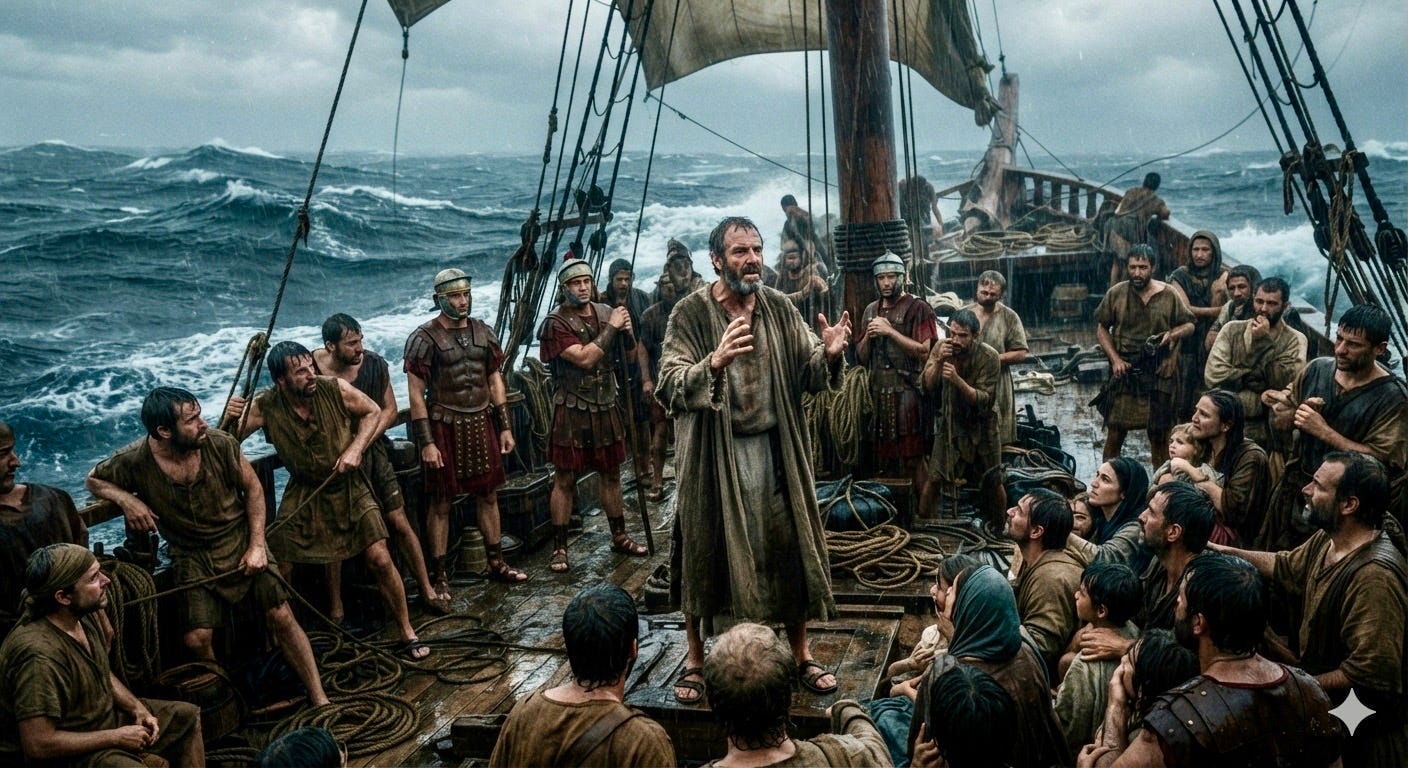
Me: Fascinating to think of Paul’s story “going viral” but for now, just create a picture of Paul’s second speech on the boat.
Google:


Comments
Post a Comment