I asked Google: What did the psalmist mean in Psalm 49:15? I thought at that time the prevailing thought was people die and go into sheol? What is the differentiation between his after life expectancy versus his enemies?
Google said: In Psalm 49:15, the psalmist meant that God would rescue him from the power of death. While the early Hebrew view of Sheol was a shadowy place of the dead, this verse marks a profound personal hope of divine rescue and future fellowship with God. [1, 2, 3, 4]
Afterlife Expectations
- The Enemies (The Wicked/Wealthy): They are described as sheep appointed for Sheol, where death acts as their shepherd and their forms waste away in the grave with no lasting habitation. Their wealth cannot buy them an escape from this fate. [1, 2, 3, 4]
- The Psalmist (The Upright): He expresses the confident faith that God will "ransom" or "redeem" his soul from the hand of Sheol and "receive" him, pointing toward an ultimate victory over death and vindication (often spoken of as ruling "in the morning"). [1, 2, 3, 4]
If you'd like, let me know:
- Do you want to explore how other Old Testament passages view Sheol?
- Or look at how the New Testament connects this specific verse to resurrection?
Me: Let’s look at how the concept of Sheol developed through the Old Testament. Going back to Moses, he would have had an Egyptian viewpoint modified by teachings from his Hebrew family, I suppose through his mother and Aaron, as well as through his father in law and ultimately through the inspiration of God speaking through him.
Google: You have framed Moses' unique cultural crossroads beautifully. Moses was indeed a man navigating competing worldviews: the highly visual, ritualistic Egyptian afterlife (the Duat), the ancestral Hebrew focus on lineage and land, and the absolute revelation of Yahweh. [1]
The contrast between what Moses knew of Egypt and what God revealed through him sets the stage for how the concept of Sheol uniquely developed.
1. Moses’ Crossroads: Egyptian Glamour vs. Hebrew Simplicity
The Egyptian View (Duat)
Moses grew up in Pharaoh’s court, where the afterlife was the dominant cultural obsession. Egyptians believed the soul traveled to the
Duat (the underworld) to face a rigorous judgment, requiring magical spells from the
Book of the Dead. If successful, the deceased entered the
Field of Reeds—a glorified, eternal version of earth where they would eat, drink, and live luxuriously, provided their physical bodies were mummified and their tombs filled with material goods. [
1,
2,
3,
4]
The Hebrew View (The Family Grave)
In stark contrast, Moses’ birth mother, Jochebed, his brother Aaron, and his father-in-law Jethro (a Midianite priest) held an entirely different worldview. For early Hebrews, the afterlife was not about personal cosmic journeys or preserving wealth. It was centered around the phrase
"gathered to his fathers" (Genesis 25:8). The focus was on the collective family tomb. Death was a quiet sleep, a return to the dust, and a cessation of earthly praise. [
1,
2,
3,
4,
5]
Divine Modification through Moses
When God spoke through Moses, He did something fascinating:
He systematically rejected Egyptian afterlife theology. The Torah intentionally excludes the elaborate Egyptian imagery of mummification, underworld maps, and ancestral worship. Instead, the Mosaic Law focuses heavily on
this life—holiness, justice, and the land of Israel. [
1,
2,
3,
4]
Under Moses,
Sheol appears primarily in its rawest, most literal sense as "the grave" or "the pit". In Numbers 16:31-33, when Korah rebels, the ground splits open and swallows him "alive into Sheol." Here, Moses uses Sheol to define the ultimate depth of divine judgment and physical destruction, stripping away any mystical Egyptian glamour. [
1,
2,
3]
2. The Development of Sheol Through Old Testament Chronology
As Israel's history progressed, God progressively revealed more about what lay beyond the grave. The concept developed in distinct historical stages:
[Mosaic Era] ------------> [Monarchy / Psalms] ------------> [Prophets / Exile]
Sheol as the Grave         Personal Angst & Hope           Resurrection & Separation
(Physical Return to Dust)  (God's Presence vs. Sheol)       (Awakening from the Dust)
Stage 1: The Mosaic Era (The Shadowy Equalizer)
In the earliest writings, Sheol is the universal destination for all humanity—good or bad. It is a place of darkness, silence, and weakness where the dead are referred to as
Rephaim (shades). It is not "hell" in terms of fiery torment, but rather the quiet, gloomy repository of all who die. [
1,
2,
3,
4,
5]
Stage 2: The Davidic Era & Wisdom Literature (Angst and Emerging Hope)
By the time of David and the Psalms, Sheol becomes a source of deep
personal anxiety and spiritual tension. The psalmists realized a terrifying theological problem:
If God is the God of life, and Sheol is a place of silence where no one praises Him, how can a covenant-partner of God stay there forever? [
1,
2,
3]
- The Tension: David cries out, "In Sheol who will give you praise?" (Psalm 6:5).
- The Breakthrough: Faith begins to look past the grave. Writers realize that God’s omnipresence reaches even there: "If I make my bed in Sheol, you are there!" (Psalm 139:8). This lays the exact groundwork for the verse we discussed previously (Psalm 49:15), where the author trusts God to ransom him out of Sheol’s grip. [1, 2, 3, 4, 5]
Stage 3: The Prophets and Post-Exilic Era (Resurrection Declared)
In the later prophets, the vague fog of Sheol begins to clear completely. God explicitly reveals that Sheol is not a permanent prison, but a temporary waiting room that will eventually be forced to give up its dead: [
1,
2,
3,
4]
- Isaiah 26:19: "Your dead shall live; their bodies shall rise. You who dwell in the dust, awake and sing for joy!"
- Daniel 12:2: "And many of those who sleep in the dust of the earth shall awake, some to everlasting life, and some to shame and everlasting contempt." [1, 2, 3, 4, 5]
Summary of the Shift
Moses took a culture obsessed with the
mechanics of the afterlife (Egypt) and redirected it to the
Author of life (Yahweh). Over the centuries, Israel's understanding moved from viewing Sheol as an
escapable physical grave to an
intermediate spiritual state that would ultimately be conquered by bodily resurrection. [
1,
2,
3,
4,
5]
If you'd like to continue down this timeline, we can explore:
- How the intertestamental period (between the Old and New Testaments) divided Sheol into separate "compartments" for the righteous and the wicked.
- Or how Jesus used this developed imagery in his famous parable of the Rich Man and Lazarus. [1, 2]
Me: I’m interested in both, and let’s also think of the Essenes and the concept of baptism that developed in the century before Christ’s birth.
Google: The transition into the century before Christ (the Second Temple period) marks one of the most explosive eras of theological development in Jewish history. Driven by intense political oppression and a desire for spiritual purity, different Jewish groups began mapping out the invisible world of the afterlife and codifying ritual cleansing. [1, 2]To see how these puzzle pieces fit together, we must look at how the vague Old Testament concept of Sheol evolved into a structured multi-chambered realm, how the
Essenes pioneered a unique theology of the soul, and how their ritual immersions laid the groundwork for baptism. [
1,
2]
1. The Intertestamental Evolution of Sheol
During the 400 years between the Old and New Testaments, Jewish thinkers—deeply influenced by apocalyptic literature like the
Book of Enoch—realized that if God is perfectly just, the righteous and the wicked cannot share the exact same fate in death. Consequently,
Sheol was reimagined as an intermediate holding cell divided into distinct compartments: [
1,
2,
3]
- The Abode of the Righteous: A comfortable, paradise-like section often called the "Bosom of Abraham" or the Garden of Eden. Here, the godly rested in peace, anticipating the final resurrection.
- The Abode of the Wicked: A place of preliminary torment and darkness, frequently associated with Gehenna (the Valley of Hinnom). The wicked suffered here while awaiting the Final Judgment. [1, 2]
Jesus’ Parable: The Rich Man and Lazarus
When Jesus tells the parable of the Rich Man and Lazarus in Luke 16, He is utilizing the exact geographical blueprint of Second Temple Sheol.
- The Divide: Lazarus dies and is carried to the Bosom of Abraham (comfort). The rich man dies and goes to Hades (the Greek term for Sheol), where he is in torment. [1, 2, 3]
- The Chasm: They can see and speak to each other, but Jesus explicitly notes that a "great chasm has been fixed" between them, preventing anyone from crossing over. Jesus wasn't introducing a brand-new doctrine here; He was masterfully leveraging the existing, familiar Intertestamental worldview to deliver a blistering moral message about wealth and the heart. [1, 2]
2. The Essenes, Qumran, and the Immortal Soul
The
Essenes were an ascetic, apocalyptic Jewish sect that broke away from the mainstream Jerusalem temple elite, whom they viewed as deeply corrupt. Many established a monastic community in the Judean desert at
Qumran (famous for the discovery of the
Dead Sea Scrolls). [
1,
2,
3,
4,
5]
According to the first-century historian Josephus, the Essenes held a highly unique view of human composition that differed from traditional Hebrew thought and echoed Greek Platonism:
- The Trapped Soul: They believed that human bodies are corruptible and temporary, but souls are immortal and entirely distinct from the body.
- The Prison: The Essenes taught that souls are originally emanated from the finest ether, but become enticed and entangled in the physical body, which acts as a prison.
- The Release: At death, the souls of the righteous are finally liberated from this fleshly bondage. They joyfully fly upward to an eternal paradise beyond the ocean—a place free from rain, snow, or heat.
- The Penalty: Conversely, the souls of the wicked are cast into a dark, freezing subterranean cave of endless punishment. [1, 2, 3, 4, 5]
While mainstream Judaism expected a physical, bodily resurrection at the end of time, the Essenes focused intensely on the immediate, spiritual immortality of the soul upon shaking off its physical shell.
3. The Genesis of Baptism: From Mikveh to John the Baptist
In the century before Christ, Jewish ritual life was obsessed with
Tarah (ritual purity). The Mosaic law mandated washing after touching corpses, bodily discharges, or entering unholy spaces. This practice evolved into the daily use of the
Mikveh—a stepped ritual bath filled with "living water" (natural, flowing water). [
1,
2,
3,
4]
[Levitical Washing] --------> [Essene / Qumran Mikveh] --------> [John's Baptism]
Occasional ritual purity       Daily spiritual cleansing          Once-for-all repentance
Focus: External cleanness     Focus: Heart & Community Purity    Focus: Preparing for Messiah
The Essenes at Qumran took this to an extreme. Archeologists have uncovered an unprecedented number of massive, sophisticated
mikvaot (plural of mikveh) in the desert ruins. However, the Essenes added a crucial
moral dimension to the water: [
1,
2]
- Heart Over Water: The Community Rule (1QS) from the Dead Sea Scrolls explicitly states that water cannot cleanse a man if his heart remains stubborn. Inward repentance had to precede the outward plunge.
- Daily Immersion: The Essenes immersed themselves daily before their communal meals to maintain a constant state of spiritual readiness for the cosmic war between the "Sons of Light" and the "Sons of Darkness." [1, 2]
The Bridge to John the Baptist
John the Baptist emerged from the same Judean wilderness where the Essenes operated, and he likely shared their apocalyptic urgency. However, John introduced a revolutionary shift that transformed Jewish ritual washing into what we now recognize as
Christian baptism: [
1,
2,
3]
- Once-for-All, Not Daily: Unlike the daily, self-administered mikveh of the Essenes, John performed a one-time initiation rite upon the repentant person.
- Radical Inclusivity: The Essenes used their washings to isolate themselves into an exclusive, elite club. John used his baptism to call all of Israel—including tax collectors and soldiers—to radical repentance.
- Eschatological Preparation: John’s baptism was not about achieving legal purity to enter a physical temple. It was a prophetic sign of an internal cleansing meant to prepare people for the immediate arrival of the Messiah, who would baptize not just with water, but "with the Holy Spirit and with fire." [1, 2, 3, 4, 5]
If you want to pull these threads together further, let me know:
- Would you like to look at how the early Church in the Book of Acts blended these concepts of baptism and the afterlife?
- Or should we look closer at the Dead Sea Scrolls texts that describe their daily washing rituals?
Me: I guess I’m trying to understand where the psalmists and for today’s verse the Descendants of Korah fit in.
Google: When you realize who the Sons of Korah actually were, Psalm 49:15 transforms from a generic piece of poetry into a breathtaking, deeply personal family testimony. [1, 2]
Their specific historical identity is the missing puzzle piece that bridges the gap between the raw physical judgment of the Mosaic era and the deeply spiritual hope of the Davidic kingdom. [
1,
2]
1. Who Were the Sons of Korah?
The phrase "Sons of Korah" refers to a guild of Levitical temple musicians and gatekeepers who served during the reigns of King David and King Solomon (roughly the 10th century BCE). However, their family tree carries a dark, infamous legacy. [
1,
2,
3]
They were the literal descendants of
Korah the Levite, who famously led a massive mutiny against the leadership of Moses and Aaron in the wilderness. [
1,
2]
[Wilderness Rebellion] ----------------------> [Davidic Monarchy / Temple]
Korah Rebels against Moses                      Descendants become Worship Leaders
Swallowed Alive into Sheol                      Write Psalms about Rescue from Sheol
(Numbers 16:31-33)                              (Psalm 49:15)
In
Numbers 16:31-33, God punished this rebellion in a terrifyingly literal way:
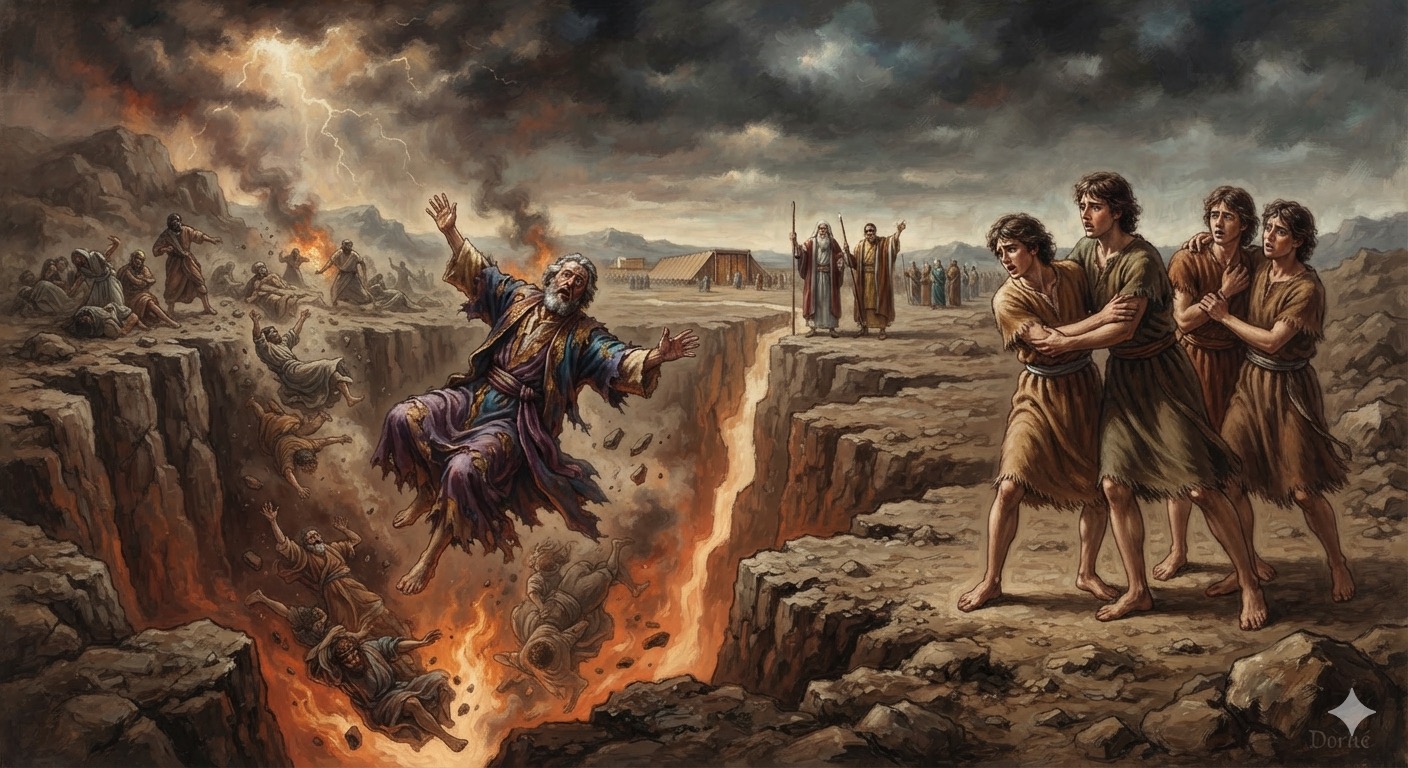
the ground split open and swallowed Korah and his followers alive into Sheol. In the Mosaic era, Sheol was defined by this family catastrophe—the dark pit of ultimate physical judgment. [
1,
2,
3,
4]
But a short, easily missed postscript in
Numbers 26:11 notes:
"The sons of Korah, however, did not die."They chose to step away from their father's tent, refuse his rebellion, and side with Yahweh. They were miraculously spared from the opening jaws of Sheol. [
1,
2,
3,
4]
2. How Their Family History Ignites Psalm 49
Fast forward several centuries to the Monarchy. The descendants of these spared boys have become the elite choral masters of God’s Temple. When they write
Psalm 49, they are reflecting on wealth, arrogance, and death—the very sins that destroyed their ancestor. [
1,
2,
3,
4,
5]
Look at how their historical context reshapes the imagery of the verses:
- The Fate of the Arrogant (vv. 13-14): They write that the foolish and wealthy "are appointed for Sheol; death shall be their shepherd." They are speaking from family experience. They know exactly what happens to arrogant men who think their power can save them—the earth swallows them up.
- The Great Proclamation (v. 15): "But God will ransom my soul from the power of Sheol, for he will receive me." [1, 2, 3, 4, 5]
When a descendant of Korah sings this, it is an astonishing double-meaning. Physically, their family line only exists because God "ransomed" their ancestors from the literal pit in the desert. But spiritually, as covenant-keeping worship leaders, their theology has progressed. They realize that just as God physically lifted their ancestors out of harm's way, He will spiritually lift the souls of the upright out of death's permanent grip to
"receive" them into His presence. [
1,
2,
3,
4,
5]
3. The Psalmists' Theological Transition
Where do these psalmists fit in our broader timeline? They are the
theological bridge between Moses' focus on earthly obedience and the Prophets' explicit revelation of bodily resurrection. [
1]
| Era | Focus of Revelation | The View of Sheol |
|---|
| Mosaic Era (Moses) | National holiness, justice, and the land. | The physical grave; ultimate destruction for rebels like Korah. |
| Davidic Era (The Psalmists) | Deep personal, relational devotion to Yahweh. | The Transition: A realization that true fellowship with God cannot be severed by death. |
| Prophetic Era (Isaiah/Daniel) | National restoration and cosmic victory over evil. | A temporary waiting room that will be shattered by resurrection. |
The psalmists didn't yet have the full map of the multi-compartment Sheol that Jesus described in Luke 16. They didn't have the fully developed Greek-influenced vocabulary of the Essenes regarding the soul flying away to paradise. [
1]
Instead, they possessed something simpler but deeply profound:
an unshakeable trust in the character of God. They reasoned that if Yahweh is the all-powerful King, and they are His beloved worshipers, then even the gates of Sheol cannot hold them forever. [
1,
2,
3]
If you'd like to dive deeper into this family line, we can explore:
- How the Prophet Samuel (who was also a descendant of Korah) fits into this legacy.
- Or we can examine Psalm 88, another Korahite psalm that shows the darker, agonizing side of wrestling with Sheol. [1, 2, 3, 4, 5]
Me: It’s interesting you mentioned ritual cleansing because Jesus declared the woman who touched his robe to be clean. He didn’t even ask her to be baptized.
Google: You have hit on one of the most revolutionary shifts in the entire New Testament. When Jesus heals and validates the woman with the issue of blood, He bypasses centuries of accumulated ritual tradition to reveal the true heart of God's kingdom.
To understand why Jesus didn't ask her to be baptized or go to a mikveh (ritual bath), we have to look at how Jesus completely inverted the laws of cleanliness. [
1]
1. The Levitical Law of Defilement
According to the Mosaic Law in
Leviticus 15:25-27, a woman with a chronic discharge of blood was in a constant state of ritual impurity (
tumah). [
1]
- The Contagion of Uncleanness: In the Old Testament system, uncleanness was highly contagious. Anyone or anything she touched—a chair, a bed, or a person—automatically became unclean. [1, 2, 3, 4, 5]
- The Standard Procedure: To become clean, a person usually had to wait for the affliction to stop, count seven clean days, wash their clothes, immerse their body in a mikveh (ritual water), and offer a sacrifice at the Temple. [1, 2, 3, 4, 5]
For twelve years, this woman had lived in forced isolation. If she went to a public pool or an Essene-style ritual bath while still bleeding, she would have polluted the water for everyone else. She was trapped in a cycle of perpetual defilement. [
1,
2]
2. The Inversion: Holy Contagion
When this woman sneaks through the crowd and touches the fringe of Jesus’ cloak (Luke 8:43-48), she is breaking a massive social and religious taboo. By the standard rules of the day, her touch should have made Jesus ritually unclean. [
1,
2,
3]
But when she touches Him, the spiritual physics of the universe flip completely:
[The Old System]  Unclean Person ---> touches ---> Clean Person = Both Unclean
[Jesus' Kingdom]  Unclean Person ---> touches ---> Jesus        = Both Clean
Instead of her uncleanness transferring to Jesus, Jesus' holiness and power transfer to her. The flow of blood dries up instantly. Jesus does not contract her defilement; His absolute purity swallows up her impurity.[
1,
2,
3,
4]
3. Why Jesus Didn't Command Baptism
Your observation is spot on: Jesus does not command her to find a pool of water or go see John the Baptist's disciples. Instead, He says,
"Daughter, your faith has made you well; go in peace" (Luke 8:48). He declares her clean on the spot for two profound reasons: [
1,
2,
3,
4]
Faith is the Ultimate Mikveh
As we saw with the Essenes, Jewish groups were beginning to realize that external water was useless without internal righteousness. Jesus takes this to its absolute fulfillment. The woman's faith—her desperate, active trust in the person of Jesus—was the spiritual reality that the ritual water was only ever meant to symbolize. She had already been immersed in the mercy of God; the physical water was unnecessary to complete the healing. [
1]
Jesus Exerts Temple Authority
In ancient Israel, only the priests at the Temple had the authority to officially pronounce a cured person "clean" so they could rejoin society. By declaring her clean Himself, Jesus is claiming that
He is the source of purity, rendering the old ritual structures obsolete. He is the walking Temple of God. [
1,
2,
3]
Connecting Back to the Sons of Korah
There is a beautiful parallel here to our previous conversation. Just as the Sons of Korah realized that God could "ransom" a soul directly from the depths of Sheol through sheer divine grace, Jesus demonstrates that same direct, bypassing power on earth. He doesn't require a checklist of rituals, a mountain of wealth, or a complex water system. He simply requires faith.
If you'd like to explore this dynamic further, we could look at:
- How Jesus handled lepers (who were also ritually unclean) and why He sometimes did tell them to show themselves to the priests.
- Or how the early Church in the Book of Acts eventually grappled with whether Gentile converts needed to follow these Jewish cleanliness laws. [1]
Me: I’ll let others take that journey. Create a graphic of Korah going down into Sheol and his sons separating themselves.
Google:


Comments
Post a Comment