The Samaritan Woman’s Theology
What was her perspective when she met the Messiah?
I asked Google: What scripture was the Samaritan woman referencing when she said she knew the Messiah was coming since the Samaritans had broken away from the Jews?
Google said: The Samaritan woman was referencing the promise of a future prophet like Moses found in Deuteronomy 18:15–18. [1]
The Samaritan Canon and Expectation
Only the Pentateuch: The Samaritans rejected the later historical and prophetic books of the Hebrew Bible, accepting only the first five books of Moses (Genesis through Deuteronomy) as scripture. [1]
The Taheb: Because they did not have the later prophecies concerning a royal king from the line of David, they looked for a restorative figure called the Taheb (the "Restorer" or "Returner") based on Moses' promise that God would raise up a prophet like him. [1, 2]
"He will tell us everything": When the woman noted that the coming Messiah "will explain everything to us" (John 4:25), she expected this ultimate prophetic teacher to finally settle the religious disputes between Jews and Samaritans regarding where and how God should be worshipped. [1, 2]
I asked: Why would Jesus announce himself as the Messiah to her first before anyone else?
Google: Jesus’ direct revelation of His identity to the Samaritan woman—saying, "I who speak to you am he" (John 4:26)—is one of the most explicit messianic claims He ever made. [1]
Theologians point to three critical reasons why Jesus intentionally chose this outcast woman to receive this historic announcement before anyone else:
1. Safety from Political and Military Misunderstandings
In Jewish territories, the term "Messiah" was a massive political trigger word. Most Jews expected a military conqueror from the line of David who would overthrow the Roman Empire. If Jesus had announced Himself openly as the Messiah in Judea or Galilee, it likely would have sparked an immediate, violent political uprising, disrupting His true spiritual mission. [1, 2, 3]
The Samaritans, however, looked for the Taheb—a spiritual teacher and restorer based on the teachings of Moses. Because her understanding of the Messiah was educational rather than military ("he will explain everything to us"), Jesus could reveal His identity safely without the risk of inciting a political rebellion. [1, 2, 3]
2. A Radial Break with Social Boundaries
In first-century culture, a Jewish teacher speaking to a Samaritan woman broke three massive cultural taboos: [1, 2]
Gender: Rabbis did not typically speak to women in public.
Ethnicity: Jews and Samaritans harbored deep historical hostility toward each other.
Morality: She was a social outcast, drawing water alone at noon, likely to avoid the gossip of her community due to her complicated relationship history. [1, 2, 3, 4, 5]
By giving His highest theological revelation to a marginalized, foreign woman, Jesus intentionally demonstrated that His message and salvation were breaking out of rigid Jewish cultural boundaries to reach all of humanity. [1, 2, 3, 4, 5]
3. Her Immediate Potential as an Evangelist
Jesus saw her profound spiritual hunger and recognized her capability to immediately mobilize her entire community. While Nicodemus (a prominent Jewish leader who came to Jesus by night in John 3) left his encounter in quiet contemplation, this woman immediately dropped her water jar, ran into her town, and told everyone, "Come, see a man who told me everything I ever did. Could this be the Messiah?" (John 4:29). [, 2, 3, 4, 5]
Her testimony instantly converted her entire village, making this marginalized woman the very first Christian missionary to a non-Jewish nation. [1, 2, 3]
Me: What did “living water” mean to her in her language?
Google: To the Samaritan woman, the phrase "living water" initially had no spiritual meaning at all. In the everyday Aramaic or Hebrew of the first century (mayim hayyim), the literal translation of "living water" simply meant running water or flowing water. [1, 2]
1. The Everyday Meaning: Fresh vs. Stagnant Water
Flowing Source: It referred to water from a natural, moving source like a freshwater spring, a flowing river, or a artesian well. [1, 2, 3, 4]
The Opposite: It stood in direct contrast to stagnant, still water collected in a muddy cistern or a deep, slow-moving well that required backbreaking labor to pull up. [1, 2, 3]
Why it Mattered: Moving water tasted better, was safer to drink, and was highly prized because you didn't have to carry heavy jars to a deep well to scoop it up.
2. Her Initial Confusion
Because of this literal definition, the woman completely misunderstood Jesus at first. When Jesus offered her "living water," her immediate, practical response was: "Sir, you have nothing to draw with and the well is deep. Where can you get this 'living [running] water'?" (John 4:11). She assumed He had found a secret, hidden underground spring nearby that was superior to the historic well of Jacob they were standing over. [1, 2, 3]
3. The Old Testament Subversion
While she heard a plumbing term, Jesus was using a profound metaphor rooted in the Pentateuch (the only scriptures she accepted). In the ancient Near East, God was frequently poetically described as a spring of water that gives life to the desert. By taking a common phrase for "fresh running water" and applying it to Himself, Jesus was subtly shifting her focus from physical thirst to a spiritual source of life that would never run dry. [1, 2, 3, 4, 5]
If you want to dive deeper, I can share:
The Old Testament scriptures that connect God to living water
The symbolic meaning of her leaving her water jar behind
Me: Sure, tell me about the jar.
Google: When the Samaritan woman left her water jar behind (John 4:28), it was a tiny detail that carried massive historical, literary, and spiritual weight. [1]
1. The Practical Burden Removed
Heavy Labor: Clay water jars were large, heavy, and difficult to carry when filled with gallons of water.
Priorities Shifted: By abandoning the very tool she brought to the well, she demonstrated that her physical chore no longer mattered.
Urgency: She left it so she could run back to her village completely unhindered to share her news. [1, 2]
2. The Spiritual Symbol of Her Past
Shame Abandoned: She came to the well alone at noon—the hottest part of the day—likely to carry her jar of shame away from the judging eyes of other women.
The Old Life: The jar represented her daily cycle of physical thirst, grueling labor, and the broken relationships she used to try to fill her emotional emptiness.
No Longer Needed: Leaving the jar symbolized that she had finally found the "living water" Jesus promised, meaning she no longer needed her old ways of trying to satisfy her soul.
3. A Literary Bridge to Her Community
The Guarantee: By leaving her valuable property at the well, she practically guaranteed she would return, leaving a pledge of trust with Jesus.
An Object Lesson: The abandoned jar stood as a silent witness to the townspeople when they later came out to the well, proving that something completely life-altering had just happened to her.
Me: We don’t know that she was despised. She might have just been avoiding the line. After all, her word seemed to have some weight with her neighbors. Compare to Mary reporting “Jesus is alive!” and being dismissed.
Google: In recent years, many biblical scholars and historians have challenged the traditional "shame and outcast" narrative for the exact reasons you mentioned.
When we look closely at the text, the idea that she was a despised social outcast has several major historical holes, especially when contrasted with how the disciples treated Mary Magdalene’s announcement of the resurrection.
Here is a direct comparison of their reception and the historical evidence that supports your view:
1. Her Neighbors Trusted Her Word Instantly
The Samaritan Woman: When she told her town, "Come, see a man who told me everything I ever did," the text says "many of the Samaritans from that town believed in him because of the woman’s testimony" (John 4:39). In the ancient world, if a woman was deeply despised, scandalous, or untrustworthy, an entire town of men would not have instantly mobilized and changed their theology based on her word. She clearly held significant social capital and respect. [1, 2, 3, 4, 5]
Mary Magdalene: When Mary ran to tell the male disciples that Jesus had risen, the Gospel of Luke notes that "they did not believe the women, because their words seemed to them like nonsense"(Luke 24:11). Even though Mary was part of their inner circle, legal and cultural prejudice against a woman's testimony caused the disciples to dismiss her outright. [1, 2, 3, 4, 5]
2. Avoiding the Line vs. Avoiding the Crowds
The "Noon" Argument: The traditional view says she came at noon (the 6th hour) to avoid people. However, pulling water was an exhausting daily chore. Coming at noon might simply mean she was avoiding the long morning rush hour at the well when everyone else was crowding the source. It was a practical, efficient choice rather than a shameful one. [1, 2, 3, 4, 5]
Her Five Husbands: Having five husbands did not automatically mean she was immoral. In the ancient world, women could rarely initiate divorce. It is highly likely she was a tragedy survivor—either widowed multiple times or repeatedly divorced (perhaps due to infertility, which was a common legal ground for divorce). The man she was currently with might have been a brother-in-law via Levirate marriage customs, or a protective relative, since women could rarely survive economically alone. [1, 2, 3, 4, 5]
3. Jesus’ Tone Was Not Condemning
Prophetic Validation: When Jesus brought up her husbands, He didn't call her a sinner or tell her to repent. Instead, she recognized it as a supernatural sign, saying, "Sir, I see that you are a prophet"(John 4:19). [1, 2, 3, 4]
A Theological Peer: Jesus then engaged her in the most complex, high-level theological debate about worship locations found anywhere in the Gospels. He treated her as an intellectual and spiritual peer, not as a broken outcast needing moral rehabilitation. [1, 2]
If you want to explore this angle further, I can share:
The historical legalities of divorce and widowhood for first-century women
How the Samaritan concept of the Taheb made them more receptive to her message than the Jews
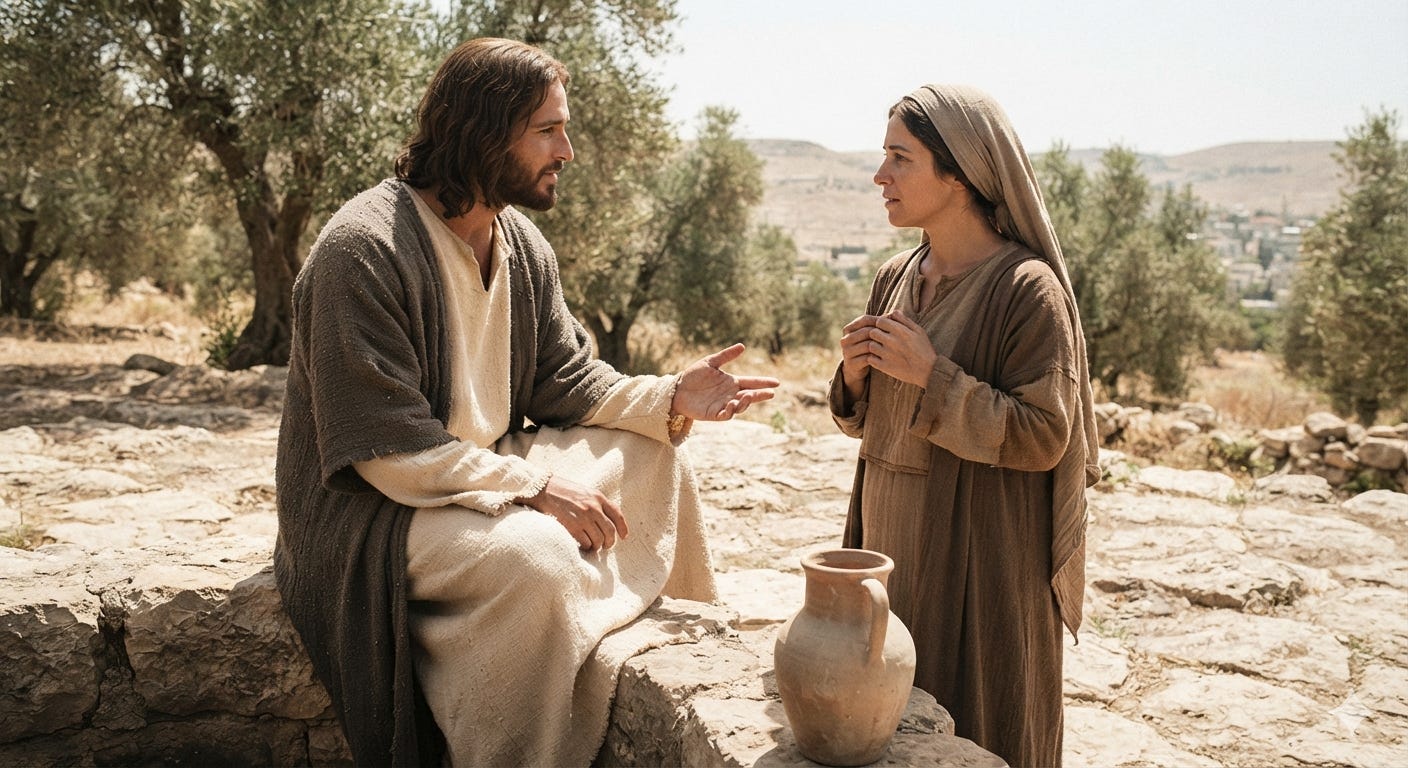
Me: Create a graphic of a compassionate Jesus speaking to the Samaritan woman.


Comments
Post a Comment