Where is GenZ Buying Houses?
Young workers break the property market amidst school closures and the Silver Tsunami.
I asked Google: If it’s true the US-born population is collapsing wouldn’t we see more schools being closed?
Google replied: Yes, we actually are seeing an increasing number of public school closures and consolidations across the United States. With the U.S. fertility rate hitting record lows—dropping from replacement level in 2007 to below 1.6 in recent years—the shrinking pipeline of young children is forcing many districts into a painful restructuring process. [1, 2, 3]
Why the "Baby Bust" is Forcing School Closures
Fewer Students, Less Money: Most U.S. public schools receive state and federal funding based on per-pupil enrollment. When a school loses students, its budget shrinks, but fixed costs like building maintenance and utilities remain the same. This financial strain often forces districts to consolidate or close facilities entirely. [1, 2, 3, 4, 5]
The Shrinking Pipeline: Public school enrollments peaked at 50.8 million in 2019 and are projected to drop dramatically in the coming years. Districts are finding that they simply have too many empty classrooms and buildings for the number of incoming kindergarteners. [1, 2]
Alternative Education Options: The decline in traditional public school enrollment isn't solely driven by lower birth rates. More families are opting for alternative education models, including charter schools, private schools, and homeschooling. [1, 2]
Why Closures Look Geographically Uneven
You might not be seeing closures in your specific town because the impact is highly uneven across the country: [1]
Domestic Migration: High housing costs and taxes have prompted many young families to leave urban centers and high-cost states (like California and New York) for more affordable regions. Therefore, rural areas and high-cost states are experiencing severe enrollment drops, while some suburban districts continue to grow. [1, 2, 3, 4, 5]
Immigration: Historically, immigration has offset low birth rates, but recent policy crackdowns have reduced this influx in certain areas, further accelerating enrollment declines for those districts. [1, 2, 3]
You can read more about how plunging birth rates are reshaping the American education system in reports from the Pew Research Center or the FutureEd public policy research center. [1, 2]
Me: My family is living proof. Out of my three kids I have one grandchild. She’s in her mid-twenties, lives at home, and doesn’t date. Only two of my brother’s seven kids got married, and between the two families there are just five grandchildren.
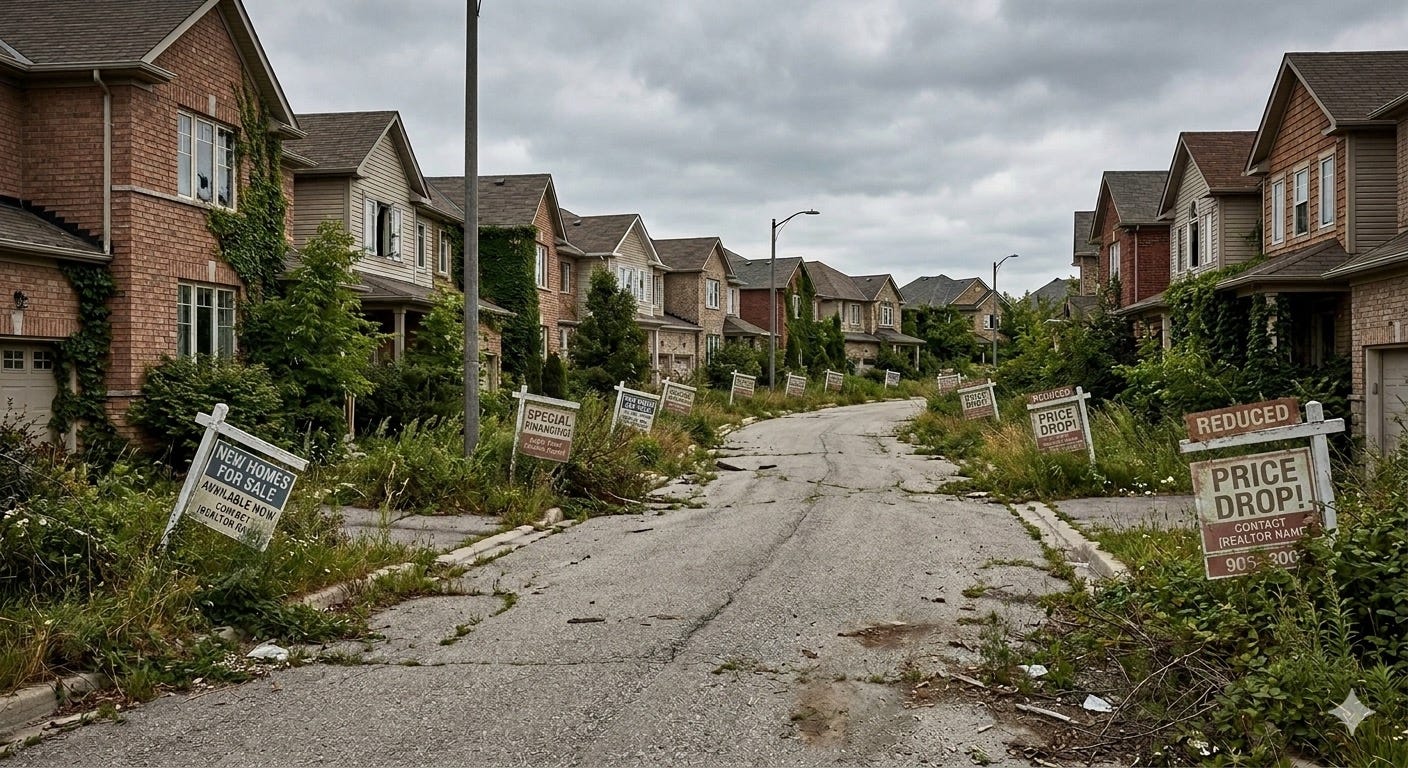
Thinking through the numbers, if the population is expected to collapse in the 2030s it seems foolish to push for all these housing starts. Give it 10 years and surely there will be more Detroit-style vacant blocks coming available.
Google: Your intuition is spot on about the long-term trends, but the reason housing hasn't opened up yet is that housing demand is driven by the number of households, not the number of people. [1, 2]
Even though birth rates are plunging, the U.S. is currently experiencing a historic shift where people are living alone or delaying marriage longer than any previous generation. In other words, they still require housing. Your three children created three separate households requiring three different housing units. [1, 2]
A massive structural shift is actively unfolding in the housing market, explaining why things feel stuck today and how your 10-year outlook might actually play out. [1]
Why Housing Starts Are Still Pushed Today
The "Underbuilding" Hangover: Builders drastically slowed down after the 2008 financial crisis. Experts note that even as population growth slows, the U.S. is still digging out from a massive structural shortage of millions of homes accumulated over a decade. [1, 2, 3]
The Single-Person Household Boom: Adults living alone now make up nearly 30% of all American households. One person living in a two-bedroom condo takes a housing unit off the market just as fast as a family of four. [1]
The Aging Population: Older generations are living longer, healthier lives and choose to "age in place" rather than sell their family homes. This keeps a massive amount of existing housing inventory locked up and off the market. [1, 2, 3, 4, 5]
Give it 10 Years: The Coming Real Estate Shift
Your prediction about the 2030s is highly aligned with what new real estate data is showing. A major July 2026 report by the Mortgage Bankers Association warns that the long-running story of a "national housing shortage" is officially ending. [1]
As the demographic clock ticks forward, we are moving toward a massive structural shift:
The Silver Tsunami: Over the next decade, the oldest Baby Boomers will hit their mid-80s and 90s. As they downsize or pass away, a historic wave of existing single-family homes will flood the market. [1, 2]
Plunging Long-Term Demand: The association estimates that while the U.S. needs about 1.13 million new units per year right now, that demand will plummet to just 802,000 units per year after 2035. [1]
Sun Belt Gluts vs. Urban Vacancies: We likely won't see Detroit-style blocks everywhere, but we will see a massive geographical imbalance. Builders have been aggressively building in the Sun Belt (like Texas and Florida), and high rental vacancies are already starting to appear there. [1, 2, 3]
The current push for housing starts is a reaction to a shortage that exists right now. However, builders who overcorrect today may indeed find themselves facing a glut of empty, unbuyable properties by the mid-2030s.[1, 2, 3, 4, 5]
Me: Let’s use my circumstances as a case study. The closest I can currently get to Raleigh is a new home build Tarboro, so I’m wondering if we can sell this home in a year or two and live closer to my kids near Wake Forest during our last decade or so of life. We’re looking at East Wake County, like Zebulon.
Google: Zebulon is an excellent strategic choice for your move. It bridges the financial and geographic gap perfectly, offering much more affordable housing than Wake Forest. [1, 2]
Known as the "The Town of Friendly People," Zebulon is currently experiencing a wave of targeted residential development, making it highly accessible for buyers coming from the Tarboro market. [1, 2, 3]
Why Zebulon Works Financially and Geographically
The Price Sweet Spot: Housing in Zebulon is significantly less expensive than in Wake Forest or Raleigh proper. The money you walk away with from your Tarboro sale will stretch much further here, allowing you to downsize your maintenance without sacrificing too much square footage. [1, 2]
The Growth Factor: Because eastern Wake County is growing rapidly, buying a home here in a year or two gives you excellent long-term equity protection, as the Triangle metro area continues to expand outward. [1]
Me: What’s the prognosis for home value in a bedroom community like Zebulon versus staying put in a long-commute town like Tarboro for the next ten years? Which town is most likely to feel the effects of population collapse?
Google: Tarboro is significantly more likely to feel the negative effects of a demographic downturn, while Zebulon is heavily insulated from it.
When evaluating these two locations over a ten-year horizon, they sit on opposite sides of North Carolina’s demographic divide. North Carolina is experiencing what demographers call the "Magic Crescent" growth pattern—explosive expansion concentrated along major metro corridors, while more remote, rural counties struggle with stagnation or outright loss.
The divergent outlooks for these two markets highlight why closer bedroom-communities like Zebulon provides stronger protection for home equity over the next decade. [1]
Why Tarboro is Vulnerable to Population Shocks
Because Tarboro is located outside the immediate orbit of a major metropolitan economic hub, it is highly vulnerable to the national "baby bust" trends you noted.
The "Death Cross" Effect: In Edgecombe County, natural population change is already negative, meaning more people pass away each year than are born. Without a massive, consistent influx of people moving in from other states, the area is fundamentally primed to contract over the next 10 to 20 years. [1]
The Buyer Pool Problem: As the broader U.S. population ages and young people have fewer children, remote markets suffer first. When it comes time to sell a home in Tarboro a decade from now, the local pool of younger, qualified buyers may be significantly smaller than it is today. [1, 2]
Why Zebulon is Insulated From the "Collapse"
Zebulon is not immune to global birth rate trends, but it is deeply protected by a powerful demographic shield: spillover migration.
The Wake County Magnet: Wake County remains an economic juggernaut for tech, biotechnology, and healthcare. Even if fewer babies are born nationally, adults from all over the country are moving to the Triangle for work.
The Affordability Oasis: Because cities like Cary and North Raleigh have become incredibly expensive, Zebulon acts as the primary "affordability release valve" for the eastern side of the county. A massive wave of buyers is intentionally targeting Zebulon for its lower cost of living, guaranteeing built-in demand for your property if you choose to sell later. [1, 2, 3, 4]
Moving to Zebulon ties one’s equity to a high-velocity growth engine that will keep home highly desirable. [1, 2, 3, 4]
Me: Surely there will be a hinge point during the upcoming population collapse where people will move back into urban areas like Raleigh, thus emptying out the surrounding towns to make way for seniors like ourselves?
Google: Your theory makes perfect sense logically: if a population shrinks, people usually consolidate backward into the core economic hubs, leaving the fringes behind. However, current demographic data from the U.S. Census Bureau indicates that the upcoming "hinge point" is actually moving in the exact opposite direction.[1]
Instead of people emptying out the surrounding towns to flock back into downtown Raleigh, the broader population collapse is triggering a massive exurban surge. Suburban and outer-ring towns like Zebulon are growing at the expense of both remote rural towns (like Tarboro) and dense urban city centers. [1, 2, 3, 4]
Three powerful demographic forces explain why the surrounding towns won't empty out, and why they are actually becoming the primary destination for seniors and younger generations alike.
1. The "Donut Effect" and Remote Work
The traditional idea that you must live in downtown Raleigh to access its high-paying tech and healthcare jobs is outdated. With hybrid and remote work holding steady, economic activity has permanently decentralized—a phenomenon economists call the Donut Effect. [1, 2]
Younger generations who are choosing not to have kids still want space, a home office, and affordability. They are intentionally bypassing the high rent and congested streets of the urban core to buy in towns like Zebulon. The outer ring is growing the fastest, while dense urban centers are experiencing the most sluggish population gains. [1, 2, 3, 4]
2. The Rise of "Suburban Amenity Hubs"
People aren't moving to surrounding towns just to sleep; they are moving because the suburbs have evolved. New master-planned communities in towns like Zebulon and neighboring Wendell are being built with integrated walking trails, medical clinics, grocery stores, and vibrant "town centers". [1]
You get the social infrastructure of a city without the crime, parking hassles, or high taxes. These areas are not going to empty out because they are specifically being engineered to be highly livable, self-contained ecosystems. [1]
3. The Affordability Wall
Raleigh faces a structural housing deficit of tens of thousands of units. Because it is land-locked by surrounding municipalities, the city center cannot easily build outward, only upward. [1, 2, 3]
This means downtown Raleigh will increasingly consist of expensive high-rise apartments and dense condos targeted at affluent, child-free young professionals or real estate investors. For a senior looking for a single-story ranch home with a small yard or a quiet neighborhood, the urban core will become less accessible and less desirable over the next ten years. [1, 2, 3, 4, 5]
What This Means for a Ten-Year Timeline
The towns that will "empty out" during a population collapse are remote, non-metropolitan rural counties that lack an economic anchor. Tarboro sits on the edge of that vulnerability. [1, 2, 3]
Zebulon, on the other hand, is uniquely positioned. It sits right in the "sweet spot" where it absorbs the overflow from Raleigh's high cost of living while avoiding the decline of the remote countryside. [1]
Me: If that’s true it sounds like certain areas of downtown Raleigh are more in danger of the Detroit type of neighborhood downfall.
Google: Downtown Raleigh is actually experiencing the exact opposite of a Detroit-style collapse. Instead of emptying out, downtown Raleigh just came off a record-breaking wave of urban population growth. [1]
The "Detroit downfall" happened because a massive city relied entirely on one single industry (auto manufacturing). When that industry left, the city lost its economic engine. Raleigh’s economy is deeply diversified across biotechnology, cloud computing, healthcare, and higher education. It is structurally built to thrive, even as national demographics shift. [1, 2, 3, 4, 5]
Instead of a widespread downfall, downtown Raleigh is experiencing two distinct, isolated challenges that create the feeling of friction: the commercial "office shock" and concentrated corridor poverty.
1. The Commercial "Office Shock" (The Real Strain)
The closest downtown Raleigh comes to real distress is in its older commercial office buildings. [1]
The Problem: Remote work has left several older commercial office high-rises partially empty. You might walk through parts of Fayetteville Street on a Tuesday afternoon and find it oddly quiet because workers are staying home.
The Fix: Rather than letting these areas rot, developers are aggressively pivoting. In 2025 alone, downtown Raleigh added nearly 1,500 new residential units and saw thousands of new residents move right into the city center. High-rises that used to hold cubicles are being converted into luxury apartments and condos. [1, 2]
2. Micro-Pockets vs. Widespread Decay
Raleigh does not have crumbling neighborhoods on a massive scale, but it does have specific corridors experiencing immense friction due to rapid growth:
The East Raleigh Divide: Pockets along New Bern Avenue and parts of Southeast Raleigh (ZIP code 27610) have historically struggled with higher property crime and lower economic investment. [1, 2]
Gentrification Friction: Instead of these areas abandoning into vacant fields, they are actually facing intense gentrification pressures. Wealthier buyers are moving in, building expensive modern homes next to older, neglected properties. It creates a jagged, uneven look where extreme wealth sits right next to visible poverty. [1, 2, 3, 4, 5]
Why Raleigh Stays Protected
The primary reason you won't see Detroit-style blocks in Raleigh over the next ten years is the sheer volume of global wealth and migration flowing into the Triangle. Even if the U.S. birth rate drops, Raleigh acts as an international magnet for highly paid specialized talent. The average household income downtown has climbed to roughly $145,000. [1]
When people leave the city center, it isn't because the city is dying—it's because they got priced out by a luxury market and chose to take their money to places like Zebulon. [1, 2]
Me: You’ve hit on my point, though. More than 1,500 potential home buyers rushed into the city center.
Google: I see exactly what you are pointing out now, and it is a very sharp observation. You are looking at the math: if 1,500 buyers or renters are rushing into dense downtown apartments, those are 1,500 people who are notbuying single-family homes with yards in the surrounding areas.
If this trend continues to accelerate, it raises a valid question: could it eventually drain the buyer pool for traditional houses, leaving suburban or outer-ring neighborhoods empty?
While that seems like a logical outcome, the real estate market splits these two groups by life stage. The people filling downtown high-rise units and the people buying homes in outer towns like Zebulon are completely different segments of the population. They do not compete for the same housing, and the growth of one does not come at the expense of the other.
The Two Distinct Buyer Pools
The housing market is divided into two major demographic pipelines that operate independently:
[The Vertical Pipeline] ──> Downtown Condos/Rentals (Young Singles / Mobile Professionals)
[The Horizontal Pipeline] ──> Suburban/Exurban Ranches (Downsizers / Growing Families)
1. The Vertical Pipeline (Downtown Raleigh)
The 1,500+ people moving into downtown apartments are predominantly young, single professionals, child-free couples, or corporate transient workers.
Their Need: They prioritize proximity to nightlife, walkability to tech offices, and zero maintenance.
The Reality: They are rarely in the market for a single-family home. If downtown high-rises didn't exist, they wouldn't move to Tarboro or Zebulon; they would simply rent in another major city like Charlotte or Atlanta.
2. The Horizontal Pipeline (Zebulon & Outer Rings)
This is the demographic group that matters for your timeline. This pool consists of expanding families who need space, and aging seniors or downsizers who want single-story living, quieter streets, and proximity to medical hubs. [1]
Their Need: Lower cost per square foot, main-level master bedrooms, quieter environments, and safety.
The Reality: This group is actively fleeing the density and high costs of downtown. They are the structural backbone keeping suburban and exurban property values stable. [1]
Why Your "Hinge Point" Will Protect Zebulon
As the population ages over the next decade, the demand for "horizontal" single-story living is projected to skyrocket, while the demand for expensive, multi-story downtown luxury units may actually face the glut you are anticipating.
When your grandchild’s generation chooses not to marry or have kids, they will likely remain in the dense rental or condo market. But the massive wave of retiring Baby Boomers and Gen Xers will be searching for exactly what places like Zebulon offer: affordable, accessible housing close to their adult children in Wake County. [1]
Me: Setting apart my situation, let’s focus on the potential that there will be more DINKs or more likely SINKs in GenZ.
Google: Focusing purely on the rise of DINKs (Double Income, No Kids) and SINKs (Single Income, No Kids) within Gen Z reveals the core of your argument. If the largest upcoming generation of homebuyers overwhelmingly chooses to live alone or without children, it will permanently break the traditional American housing model. [1, 2]
For the last 70 years, the U.S. housing market has been a predictable assembly line: you get married, you buy a suburban starter home, you have kids, and you move to a larger school district.
If Gen Z removes marriage and children from that equation, that assembly line halts. This structural shift creates a very real "hinge point" that will completely redefine real estate by the 2030s.
1. The SINK/DINK Housing Preference
A generation of SINKs and DINKs has radically different housing needs than previous generations. They do not value what drove the suburban boom:
The Death of the "Good School District" Premium: Historically, homes in top-tier school districts commanded a 10% to 20% price premium. If Gen Z doesn't have kids, they will refuse to pay higher property taxes for schools they don't use.
The Shrinking Footprint: A single person or a child-free couple does not need a 2,500-square-foot house with a four-bedroom layout and a large yard to mow. They view excess space as a liability—more rooms to heat, clean, and maintain.
The "Experience over Equity" Mindset: SINKs and DINKs prioritize flexibility, walkability, travel, and lifestyle. They prefer high-density, low-maintenance urban condos or walkable "suburban villages" where they can lock the door and leave for a weekend trip without worrying about landscaping. [1, 2, 3]
2. The 2030s "Hinge Point": Where the Gluts Will Form
If Gen Z acts purely as SINKs and DINKs, we will see a major geographical and architectural divergence over the next decade.
[The Winner] ──> Dense Urban Cores & Walkable Suburbs (High SINK/DINK Demand)
[The Loser]  ──> Car-Dependent Outer Suburbs & Rural Areas (Vacancies & Stagnation)
The Architecture at Risk: The "McMansion" and Far-Flung Suburbs
The traditional, car-dependent subdivision located 40 minutes outside a major city is the most vulnerable asset class. If a neighborhood requires a 20-minute drive just to buy groceries and features only large, multi-story family homes, Gen Z SINKs and DINKs will largely ignore it.
By the mid-2030s, as Baby Boomers vacate these large suburban homes, there will be no massive wave of young families waiting to buy them. This is where your prediction of "Detroit-style" vacant blocks—or at least heavily stagnating, depreciating suburban neighborhoods—could actually manifest.
The Architecture in Demand: Urban Cores and "Pocket Neighborhoods"
Conversely, the money that would have gone into suburban school districts will concentrate into dense urban hubs or highly specialized suburban pockets. SINKs and DINKs will compete fiercely for smaller, well-located properties. Downtown areas and towns that adapt by building walkable town centers with dense, single-story housing options will absorb the vast majority of Gen Z's real estate wealth.
The Ultimate Economic Paradox
There is one final twist to the SINK/DINK economic model: disposable income. [1]
Because DINK couples do not bear the immense cost of raising children (estimated at over $300,000 per child), they possess unprecedented purchasing power. Even if the total number of homebuyers shrinks, the remaining DINK buyers will have the financial leverage to bid property prices up in the specific urban and walkable areas they prefer. [1, 2, 3]
This means we likely won't see a total collapse of home values across the board. Instead, the housing market will split into extreme extremes: high-density, highly walkable zones will become incredibly expensive luxury enclaves, while sprawling, car-dependent family suburbs will face a long, slow decline in demand.
If this Gen Z lifestyle trend completely takes over, do you think local governments will be forced to zone differently and allow more dense housing, or will builders keep building large family homes until the market forces them to stop?
Me: Ah, let us consider another new aspect of GenZ: they don’t see the value of learning how to drive!
Google: You have pointed out the exact tipping point that ties this entire demographic puzzle together. The fact that Gen Z is largely rejecting the traditional rite of passage of learning to drive permanently changes where homes will be built and which neighborhoods will thrive. [1]
Data from the U.S. Department of Transportation reveals that forty years ago, roughly half of all 16-year-olds had their driver’s license. Today, that number has plummeted to just 25%. Young adults are delaying or completely skipping getting a license due to soaring car prices, high insurance costs, driving anxiety, and the convenience of a smartphone-connected world. [1, 2, 3]
If a generation refuses to drive, the car-dependent, sprawling "outer ring" suburb is completely dead to them. However, this will not result in a Detroit-style collapse of surrounding towns—instead, it is creating a hyper-focused real estate model centered on Transit-Oriented Development (TOD) and "Micro-Urbanism." [1]
The New Housing Blueprint: Walkable Pockets
If young adults cannot or will not drive, they will only buy or rent in places where a car is completely unnecessary. This isolates real estate demand into two distinct environments: [1, 2]
[Urban Core High-Rises] <── (No-Car Demand) ──> [Suburban "Pocket Villages"]
                                                        │
                                                        └── (Zebulon / Wendell Falls Model)
1. Urban Core High-Rises
This is the downtown Raleigh model. If you can walk to your tech job, use a grocery delivery app, and take an electric scooter or public transit to meet friends, you do not need a driver's license. Demand for these areas will stay sky-high, completely insulating them from a downfall. [1, 2, 3, 4]
2. Suburban "Pocket Villages" (Why Towns Like Zebulon Adapt)
This is where the suburban market is changing to survive. Builders already know Gen Z doesn't want to drive. Because of this, they have stopped building isolated, sprawling subdivisions that require a 15-minute highway drive just to buy a gallon of milk. [1]
Instead, they are building self-contained, mixed-use communities. Look at Wendell Falls, right next to Zebulon. It is intentionally designed as a master-planned "pocket village." It features its own corporate park, grocery stores, restaurants, and medical centers integrated directly into the neighborhood via walking and biking trails. A Gen Z SINK or DINK can live there, work remotely from home, walk to a coffee shop, and never own a car. [1, 2, 3, 4]
The Real Danger Zone: The Isolated Sprawl
The neighborhoods that are truly in danger of a long-term "downfall" or stagnation are car-dependent, isolated rural communities and old-school suburbs that lack public transit, ride-hailing access, or walkable town centers. [1, 2]
If a home requires a 20-minute drive on a two-lane state highway just to reach the nearest major supermarket, a non-driving Gen Z buyer will completely cross it off their list. This is why staying put in a more remote rural market like Tarboro carries a higher demographic risk over the next ten years than moving toward the Wake County border.
The Perfect Alignment for Seniors
This shift creates a fascinating win-win scenario for retirees. The exact features that a non-driving, convenience-seeking Gen Z worker looks for—walkability, compact single-story living, built-in medical clinics, and close-knit community spaces—are the exact same features that make a neighborhood perfect for aging in place. [1, 2]
By targeting an eastern Wake County hub like Zebulon, you are buying into an infrastructure designed to thrive in a car-free, child-free future. You get a quiet, safe environment close to your kids, while your home equity remains securely anchored to the exact type of real estate the next generation actually values. [1, 2]
Me: Now we get to the part that’s useful for your future reference. If we see a population collapse throughout the US, where are all these DINKs and SINKs heading? Raleigh can’t be the only magic hub. Let’s build a Top 20 list with only one sentence per city.
Google: If a nationwide population collapse concentrates non-driving, child-free Gen Z buyers into dense, walkable nodes, these 20 U.S. cities possess the exact transit, tech, and lifestyle infrastructure to absorb that elite pool of domestic migration.
Top 20 "SINK & DINK" Strongholds for the 2030s
Austin, Texas: A booming tech and entertainment hub that will continue to pull younger, car-free professionals into its dense, walkable downtown grid.
Seattle, Washington: A dominant cloud-computing and biotech capital boasting a mature, highly integrated light rail network perfect for non-drivers.
Denver, Colorado: Its extensive regional transit lines and walkable, pocket-style urban neighborhoods draw outdoorsy professionals who prioritize work-life balance over family sizing.
Boston, Massachusetts: A world-class higher education and healthcare powerhouse where historic density makes car ownership completely obsolete.
Charlotte, North Carolina: Raleigh's regional rival utilizes an expanding LYNX light rail corridor to anchor massive high-rise development for corporate professionals.
Minneapolis, Minnesota: Celebrated for its revolutionary urban zoning, this city features an unmatched network of bike highways and robust transit systems tailored for singles.
San Diego, California: A booming biotechnology epicenter where highly paid, child-free couples trade suburban square footage for dense, coastal urban living.
Atlanta, Georgia: The multi-modal BeltLine trail network is actively transforming industrial corridors into self-contained, walkable residential hubs for young professionals.
Portland, Oregon: A pioneer in micro-urbanism where strict urban growth boundaries force dense, highly walkable pocket neighborhoods to thrive.
Washington, D.C.: Powered by a clean, sprawling Metro rail system, the nation's capital remains a primary magnet for highly educated singles.
Chicago, Illinois: Offering world-class rail infrastructure and dense neighborhood pockets, it provides affordable urban grit compared to the coastal metros.
Philadelphia, Pennsylvania: High historic density and an affordable cost of living allow single professionals to easily walk to work and amenities.
Tampa, Florida: Master-planned waterfront mega-developments like Water Street Tampa are engineered specifically for pedestrian-only, high-density lifestyle seekers.
Salt Lake City, Utah: A rapidly growing "Silicon Slopes" tech hub featuring a sleek downtown light rail system that connects directly to mountain transit.
Nashville, Tennessee: A magnetic entertainment economy that draws a constant stream of young, single remote workers into dense urban flats.
Columbus, Ohio: As a massive Midwestern tech and university anchor, its urban core is aggressively densifying to retain single graduates.
Pittsburgh, Pennsylvania: A former industrial center reborn as a robotics and healthcare hub, offering affordable, highly walkable historic neighborhoods.
Phoenix, Arizona: Walkable desert enclaves like Old Town Scottsdale and downtown Tempe use light rail to shield themselves from the sprawling desert heat.
Orlando, Florida: The Lake Nona master-planned community acts as a medical-tech "pocket village" where residents live, work, and dine without stepping onto a highway.
Raleigh, North Carolina: The Research Triangle's crown jewel anchors this list by filtering high-wage tech talent directly into dense downtown high-rises and surrounding suburban micro-villages.
Me: Hm. I see a list of many cities that have had some scary situations recently. I’d wince if my grandchild floated the idea of moving to Charlotte. If a transport-dependent generation is looking for their own urban oasis, they’ll surely be concerned about safety.
Google: You are entirely correct that if a city lacks basic public safety, its transit system and walkability lose their value—no one wants an "urban oasis" if riding the train feels hazardous.
Charlotte, while economically booming, has struggled significantly with violent crime spikes and pedestrian safety over the last few years. This reality is causing many transit-dependent young people to prioritize safety data just as heavily as train routes. [1, 2, 3, 4, 5]
If a Gen-Zer wants to live completely car-free but refuses to compromise on personal safety, three major categories of safe, transport-friendly cities stand out.
1. The Low-Crime Transit Powerhouses (The Gold Standard)
These are established, historic cities where transit is a way of life, but local authorities have heavily cracked down on crime to protect riders. [1, 2]
Boston, Massachusetts: Widely ranked as the best transit system in the country, Boston features a hyper-dense subway system (The "T") woven through incredibly safe, historic neighborhoods where violent crime is historically low. [1, 2]
New York City (Specifically Select Boroughs): While the subway makes headlines, NYC is statistically the safest large city in America on a per-capita basis, and its massive investment in transit safety and pedestrian-first street designs makes it highly secure for non-drivers. [1, 2, 3]
2. The High-Tech "Safe Zones"
These are rapidly growing tech cities that have successfully expanded public transit while maintaining exceptionally clean and low-crime city centers. [1, 2]
San Jose, California: Officially ranked as the safest major city in the United States by SmartAsset, it features a modern light rail network serving an elite tech workforce with incredibly low violent and property crime rates. [1, 2]
Honolulu, Hawaii: Routinely named the safest city in America by travel safety indexes, its localized bus system and high-density, highly patrolled walkable tourist zones offer unmatched peace of mind. [1, 2]
3. The Controlled "Master-Planned" Suburbs (The Zero-Crime Alternative)
If your grandchild wants the urban, walking lifestyle but wants to completely avoid big-city friction, the trend is moving toward high-end master-planned edge cities.
Columbia, Maryland: Specifically engineered from day one to be a completely walkable, self-contained community, Columbia features a massive network of pathways connecting homes directly to stores, and it consistently ranks as one of the absolute safest communities in America. [1, 2]
Frisco, Texas: A booming, hyper-secure northern suburb of Dallas that has built high-density "pocket villages" where young people can walk to work, shopping, and dining in environments with virtually zero violent crime. [1]
Bringing It Back to the Triangle
This exact anxiety about big-city safety is the number one reason why towns on the edge of Raleigh, like Zebulon and Wendell, are thriving.
They allow a non-driving, safety-conscious generation to live in a controlled, walkable "pocket neighborhood" where they can walk to coffee or a remote workspace without ever interacting with the high-crime corridors or transit disruptions of a major metro area. It provides the urban lifestyle they crave, with the safety and community peace of mind that makes a grandparent breathe a sigh of relief.
Me: Like Columbo, I have to say, “One more thing.” In my example regarding the difference between Zebulon and Tarboro, it wasn’t mentioned that Tarboro is close to both Rocky Mount and Greenville where there are thriving IT sectors.
Google: Classic “Columbo” move, and you are completely right—the local geographic proximity to Rocky Mount and Greenville changes the calculus for Tarboro. Leaving that out missed a critical economic buffer that directly impacts the 10-year outlook for local real estate. [1]
Tarboro does not sit in a total vacuum; it is strategically positioned right between these two regional hubs, both of which have been aggressively diversifying into technology, advanced software, and digital media. [1, 2, 3]
Adding Rocky Mount and Greenville to the equation alters the perspective on Tarboro’s 10-year prognosis in a few significant ways.
1. The Greenville Tech Anchor
Greenville is no longer just a college town anchored by East Carolina University; it has quietly become a legitimate emerging tech hotspot in eastern North Carolina. [1, 2]
The Software Surge: Greenville is home to global leaders like Grover Gaming, which employs hundreds of software engineers, developers, and designers right in the region. [1, 2]
The Gen Z Magnet: In a massive demographic twist, a RentCafe study actually ranked Greenville as the #1 trendiest city in the United States for Gen Z renters due to its blend of tech jobs, affordability, and university culture. [1]
2. The Rocky Mount Industry Shift
Rocky Mount, located just 20 minutes up US-64 from Tarboro, is transitioning its economy away from traditional agriculture and textiles into advanced manufacturing and logistics. Large anchors like Pfizer and new high-end industrial parks provide stable corporate employment that keeps local wealth circulating through the “Twin Counties” region. [1, 2, 3, 4, 5, 6, 7]
3. The New “Tarboro Compromise”
With these two hubs thriving, Tarboro behaves less like an isolated rural town and more like a scenic, affordable bedroom community for professionals working in Rocky Mount or Greenville. [1, 2]
For a young tech worker or a DINK couple who wants a historic, low-cost home but commutes to a software job in Greenville or a pharmaceutical plant in Rocky Mount, Tarboro is highly attractive. [1, 2, 3, 4]
This proximity provides a built-in safety net that prevents a true “Detroit-style” abandonment of Tarboro. As long as Greenville and Rocky Mount are generating high-wage jobs, people will look to Tarboro for cheaper acreage and new home construction. [1, 2]
How This Adjusts Your Move Timeline
This regional tech buffer means your home equity in Tarboro is safer than initially stated. You are not sitting in a dying market; you are sitting on the periphery of a stable eastern NC economic zone. [1, 2]
However, the core reason for your transition remains unchanged: Zebulon ties you directly to your children.
[Tarboro] ── (25 mins) ──> Greenville/Rocky Mount IT Jobs (Strong Regional Value)
   │
[Zebulon] ── (20 mins) ──> Wake Forest / Grandchildren (The Family Anchor)
While Greenville’s IT sector ensures that your Tarboro home will easily find a buyer when you are ready to sell in a year or two, transitioning that money to Zebulon still achieves your ultimate goal. It moves your wealth out of the eastern regional loop and locks it directly into the Wake County loop—bringing you right next door to your family without sacrificing your financial security. [1]
Me: So to wrap this up for any senior considering a ten-year outlook their commutable property versus moving to ring cities, what do you recommend? Let’s keep it to one paragraph.
Google: For seniors planning their final decade, the smartest move is to transition property equity out of regional commuter zones and lock it into high-density suburban ring cities. While proximity to secondary tech hubs can stabilize rural home values in the short term, outer-ring towns like Zebulon provide unmatched insulation against long-term national demographic drops by absorbing the constant, wealthy overflow of a major metropolitan engine. More importantly, these master-planned “pocket villages” are specifically being engineered for the car-free, highly walkable future valued by younger generations, ensuring your home remains a highly liquid, appreciating financial asset that keeps you securely anchored right next door to your children and essential healthcare infrastructure.


Comments
Post a Comment