Gods of the Deep: Smash-Down!
Psalms as Trash-Talk
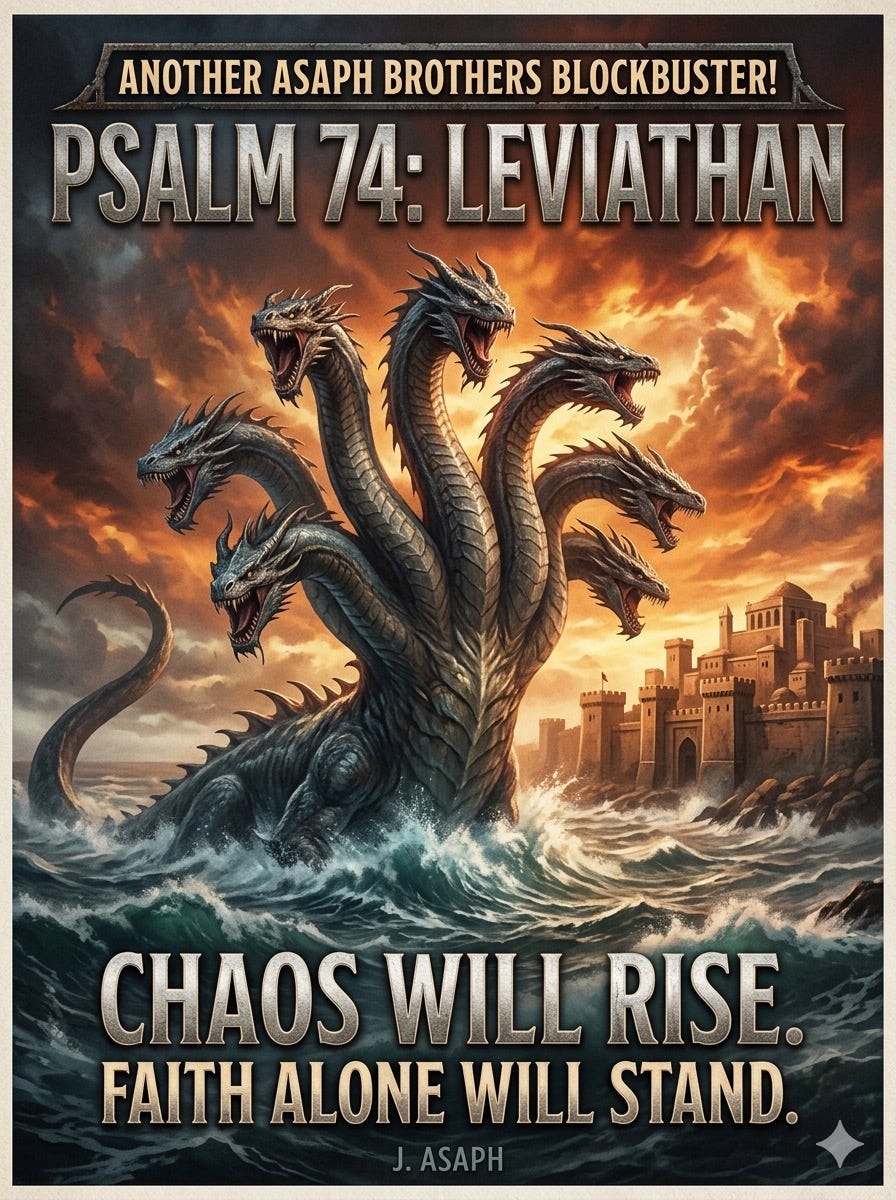
13 It was you who split open the sea by your power; you broke the heads of the monster in the waters. 14 It was you who crushed the heads of Leviathan and gave it as food to the creatures of the desert. (NLT)
I asked Google: Explain Psalm 74:13-14 because I’m like, what's this now?
Google: Psalm 74:13–14 uses epic, dramatic poetry to remember God's great power. The writer is freaking out because enemies just wrecked the holy temple. So, they hype God up by talking about how He crushed ancient sea monsters like Leviathan and split the sea, proving He can handle big messes. [1, 2, 3, 4, 5]
The Big Picture: Why God is Talking About Monsters
The Context: The writer is looking at a destroyed city and a burned temple, wondering why God is being so quiet.
The Shift: Right after complaining, the writer says, "Wait, you're the King who does mighty stuff."
The Point: The "sea monsters" and "Leviathan" are poetic symbols for chaos, evil, or big stubborn enemies (like Pharoah and the Egyptians at the Red Sea). [1, 2, 3, 4, 5, 6, 7]
Breaking Down the Verses
Splitting the sea (v.13): This is a throwback to the Exodus when God parted the Red Sea to save His people. [1, 2, 3]
Breaking the heads of the dragons/monsters (v.13–14): Ancient stories used sea monsters to mean "total chaos." God is showing He stomps out chaos. [1, 2, 3]
Feeding Leviathan to desert creatures (v.14): A vivid way of saying, "You didn't just beat the scariest thing out there; you made it food for the scavengers." It means the ultimate threat was totally defeated and humiliated. [1, 2, 3, 4]
If you want, tell me:
Are you looking at this for a personal study or a church group?
Do you want to look at how to apply this to feeling stressed or abandoned today?
Me: So I’m picturing this thing with more than one head at some water-parting event which the writer assumes is local knowledge even though it never made it into biblical text.
Google: You have actually hit the nail right on the head, and your intuition is incredibly spot-on. What you are describing is exactly what is happening—but with a fascinating historical twist.
The image of a multi-headed sea serpent did make it into the biblical text right here in Psalm 74:14, but because it's written as poetry, later generations lost the cultural context and stopped picturing it literally. [1, 2]
1. It Was Ancient "Local Knowledge"
The writer of this Psalm wasn't inventing a new monster. One post on Quora suggests they were borrowing from Canaanite mythology, which was the dominant "local knowledge" of the Ancient Near East. [1, 2, 3, 4]
This theory holds water. In the 1920s, archaeologists dug up clay tablets in Syria from an ancient city called Ugarit. These tablets contained the Baal Cycle, which was written long before the Psalms. In those texts, there is a terrifying, seven-headed sea serpent named Lotan (sound familiar? Lotan \(\rightarrow \) Leviathan). The Canaanite text explicitly says: [1, 2, 3, 4, 5]
"When you smite Lotan, the slippery serpent, make an end of the wriggling serpent, the tyrant with seven heads..." [1]
2. Why Did the Biblical Writer Borrow It?
The Hebrew writers did this a lot. It was an ancient form of cultural trash-talking. [1, 2, 3]
The Canaanites bragged that their god, Baal, defeated the seven-headed monster of chaos. The writer of Psalm 74 basically hijacks their popular monster story and says, "Uh, actually, our God Yahweh is the one who crushed the heads of Leviathan and fed him to the desert scavengers. Your god didn't do that; ours did."[1, 2]
3. How It Blends with the "Parting of the Water"
The reason you are connecting it to a "parting of the water event" is because the Bible constantly uses this monster as a poetic code name for Egypt. [1, 2, 3]
To the ancient Jewish mind, Egypt was the big, scary, chaotic superpower.
When God split the Red Sea and drowned Pharaoh's army, it looked like God was literally smashing a sea monster in the waters.
Psalm 74:13–14 purposefully blends the historical Exodus event (parting the sea) with the mythical language of smashing a multi-headed dragon to make the victory sound as epic as possible. [1, 2, 3, 4, 5]
4. It Actually Did Make It to the End of the Bible
While Leviathan's literal seven heads aren't deeply detailed in the Old Testament, the imagery re-emerges vividly in the New Testament. [1, 2]
When John writes the Book of Revelation, he describes a terrifying beast rising out of the sea. How is it described? An enormous sea dragon with exactly seven heads. John was pulling from the exact same ancient Leviathan imagery to describe ultimate evil. [1, 2, 3, 4, 5]
If you want to keep digging into this, let me know:
Do you want to see where else Leviathan pops up in the Bible (like the book of Job)?
Would you like to know more about how ancient near-eastern poetry works?
Me: There were a couple other water-parting events recorded as well, such as the crossing of the Israelites over Jordan into the promised land. Although I just watched a Biblical Archaeology show about the spot in the river Jordan where John baptized people and it’s not that wide.
Google: The modern Jordan River is a tiny fraction of its ancient self, which is why seeing it on TV today can be so underwhelming. [1, 2]
You are completely right to notice the contrast. Today, the Jordan River near the baptismal sites often looks like a muddy, narrow creek—in some places less than 30 feet wide and just a few feet deep. However, the geography of the Bible was vastly different from what we see on modern tours. [1, 2, 3]
Why the River Cooled Down (Modern vs. Ancient)
Dams and Diversions: In the mid-20th century, modern nations (Israel, Jordan, Syria, and Lebanon) began heavily damming the river and diverting over 90% of its water for agriculture and drinking water.[1]
The Ancient Reality: In antiquity, the Jordan River was deep, fast-moving, and highly turbulent. During the spring thaw from Mount Hermon, the river would completely overflow its banks, widening the valley into a rushing flood zone up to a mile wide. Crossing it on foot naturally was completely impossible. [1, 2, 3, 4, 5]
The Four "Water-Parting" Events
Because you mentioned the other recorded events, there are actually four distinct times in the biblical narrative where a body of water is miraculously split. They act like a grand historical bookend: [1]
Moses at the Red Sea (Exodus 14): The massive, nationwide deliverance from Egypt. [1]
Joshua at the Jordan River (Joshua 3): The entry into the Promised Land. The text specifically notes that the river was at its maximum flood stage when the water suddenly piled up 20 miles upstream near a town called "Adam". [1, 2, 3, 4]
Elijah at the Jordan River (2 Kings 2:8): Right before Elijah is taken to heaven in a whirlwind, he strikes the Jordan River with his cloak, and it parts so he and his successor can cross. [1, 2, 3, 4, 5]
Elisha at the Jordan River (2 Kings 2:14): Immediately after Elijah leaves, Elisha takes the same cloak, strikes the water again, and it parts back the other way, proving to everyone that he is the new chosen prophet. [1, 2, 3, 4]
The Symbolic Link to John the Baptist
When John the Baptist sets up his ministry exactly at this river, he isn't just picking a random spot with water.[1]
By submerging people in the Jordan River, John was recreating the ultimate cultural memory. He was telling the people, "Just like our ancestors had to cross the parted waters of the Jordan to leave the wilderness and enter the Promised Land, you need to go through these waters spiritually to prepare for God's new kingdom."[1, 2, 3, 4, 5]
If you want, tell me:
What tv show or documentary were you watching? (I can help add context to the specific site they filmed!)
Do you want to know more about the weird geology of the Jordan River valley (it sits on a major seismic fault line)? [1]
Me: No I wonder if there was a snake-killing event that Psalm 75 might reference…although the less literal idea of just trash-talking seems plausible.
Google: The "cultural trash-talking" idea is absolutely the winner here. You are thinking about it exactly the way some modern scholars do. There is no historical records or lost biblical texts describing a literal, physical multi-headed snake being killed at the Jordan River or the Red Sea.
Instead, it all comes down to ancient poetry and how people used to brag. When you look at how Psalm 74 and Psalm 75 function together, it becomes clear that it's a poetic masterclass in putting down enemies. [1]
Why Trash-Talking Makes the Most Sense
In the ancient world, people didn't separate the physical world from the spiritual/mythological world. If a nation conquered you, they didn't just say, "Our army is bigger." They said, "Our god is stronger than your god."
By using the image of a multi-headed sea monster, the writer is doing three things at once:
Mocking neighboring religions: Taking the scariest monster from Canaanite mythology (Lotan/Leviathan) and saying Yahweh uses it for fish bait. [1, 2]
Insulting Egypt: Using the "sea dragon" as a metaphor for Pharaoh. Dropping Pharaoh's army in the Red Sea was metaphorically "smashing the dragon's heads in the water". [1]
Setting up Psalm 75: Psalm 74 and 75 are written by the same group (the Sons of Asaph) and are meant to be read together. Psalm 74 complains that the enemy is winning; Psalm 75 is God's response.[1, 2, 3]
The Symbolism Continues in Psalm 75
If you read Psalm 75, the snake imagery disappears, but the trash-talking gets dialed up to an eleven. God steps up to the microphone and tells the arrogant enemies: [1]
"Do not lift up your horns against heaven; do not speak with an insolent neck." — Psalm 75:5
In ancient poetry, "horns" were a symbol of military power and aggressive pride (like a wild bull flexing its strength). God finishes the song by saying He is going to "cut off the horns of all the wicked". [1, 2, 3]
So, there was no literal reptile hunting. The writer is just using the absolute wildest, most dramatic imagery available in their culture—seven-headed sea dragons and charging bulls—to scream, "Our God is the ultimate judge, and He is going to humble you." [1, 2]
If you want to keep exploring this poetic world, let me know:
Do you want to see how other cultures used similar dragon stories (like the Babylonians)?
Are you interested in the historical events happening when these specific Psalms were written?


Comments
Post a Comment